UWM was formed from predecessor institutions in 1956. The Retired Faculty Association (RFA) was formed shortly thereafter in December 1961. Inspired by retired faculty who expressed a desire to stay engaged in the UWM community, the RFA’s formation was supported by the UWM Faculty Welfare Committee. This committee met on several occasions in the fall of 1961, had resounding support from then-Chancellor J. Martin Klotsche, and on Dec. 7, 1961, sponsored the first organizational meeting. The interim chair was John Lazenby (director of secondary education, retired). The first official meeting of the RFA was held on Feb. 7, 1962.
As of May 2012, the RFA was renamed the UWM Retirees Association and opened up to all UWM faculty and staff retirees.
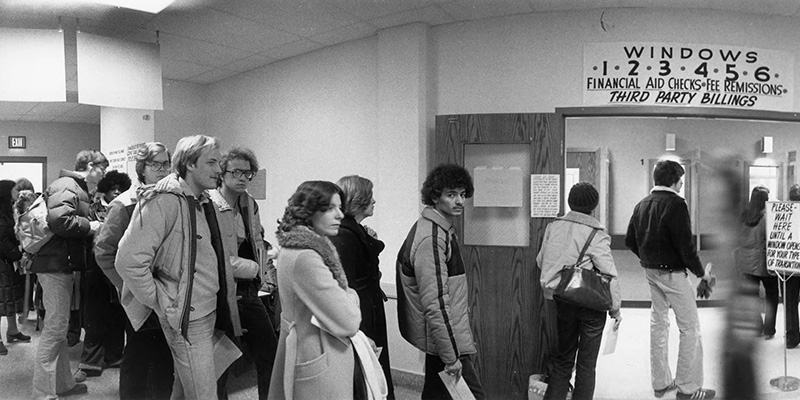
1956-1986 – UWM’s First 30 Years and UWM RFA’s First 25 Years
During this period, UWM went through a rapid and substantial growth of property, buildings, programs, schools & colleges, staff and students. All had steadily increased.
- The 8,713 enrolled students and 613 faculty in 1961 had grown to 26,325 students and 800 faculty by 1986.
- The RFA membership grew as well, from 63 members in 1964 to 174 by 1986-87.
- As the RFA developed, it published newsletters, maintained a bank account, provided scholarship support (initially funded to commemorate the passing of retired colleagues) and conducted programs of interest for its members.
- One of RFA’s initial goals was supporting outstanding scholars, and it remains a goal today. During this early period, the RFA’s scholarship contributions were a modest $100-$150 per year.
- The initial UWM Liaison was George Richard, director of news services.
- The RFA was affiliated with the UWM Alumni Association from 1967-69.
- In January 1969, the RFA’s UWM liaison became the newly formed Division of University Relations.
- In January 1978, the RFA created a Retired Faculty Economic Benefits Committee to monitor State of Wisconsin retirement benefits issues. After ascertaining that no other UW campuses had retired faculty organizations with whom to affiliate, the committee established a liaison with the Wisconsin Retired Teachers Association in 1980.
- In 1981, for the RFA’s 20th anniversary, the RFA commissioned Professor Emeritus Burton Potterveld (Art Department) to develop an RFA logo.
1987-1996
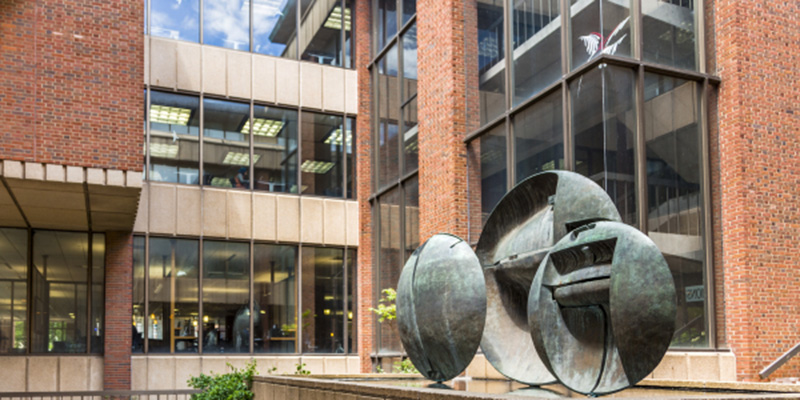
In this decade, UWM constructed several new buildings of significance, while student enrollment and the number of faculty both decreased. The Architecture and Urban Planning building was completed in 1993, followed in the mid-1990’s by Lubar Hall (School of Business Administration), the north wing of the Golda Meir Library, and the northern enclosure addition to the UWM Student Union.
- The RFA document Rights, Privileges and Opportunities for UWM Retired Faculty was approved on July 17, 1989.
- In 1993, at the RFA’s request, Sandra Hoeh-Lyon, assistant chancellor of University Relations, arranged for RFA members to continue receiving the UWM Report (the faculty/staff newsletter).
- By 1996, student enrollment had dropped to 21,969 and the number of faculty, in a slower decline, to 729. UWM witnessed continued growth in academic programs, especially at the graduate level.
- The RFA continued its growth to 230 members, and the annual contribution for student scholarships was now about $500.
1997-2006
New UWM buildings included the Sandburg East residence tower (2001) and the Klotsche Center Pavilion addition (2006). UWM also completed a major remodel of the Kenilworth Building in 2006. The Helene Zelazo Center for the Performing Arts—formerly the Congregation Emanu-El B’ne Jeshurun—was acquired in the fall of 2000.
- The number of UWM’s faculty had decreased to a low of 673 in 1999, then increased again to 769 in 2006. Student enrollment grew throughout this decade to a high of 28,356 in 2006.
- RFA now had over 300 members. In 2001, the RFA raised its annual dues from $2 to $5, which, combined with additional contributions by members, enabled the RFA to make scholarship fund contributions averaging about $1,350 per year.
- Several large endowments led to the renaming of several schools: the Helen Bader School of Social Welfare and the Sheldon Lubar School of Business Administration. In addition, the Division of Outreach and Continuing Education Extension was renamed the School of Continuing Education.
- The RFA requested that the UWM University Committee establish a policy that keeps emeriti faculty on department lists in the UWM web and print directories. The committee expanded the request from just emeriti faculty to all retired faculty. The Faculty Senate approved this request in October 2003.
- The UWM University Committee clarified in 2004 that emeritus/status includes email and web access.

2007-2011
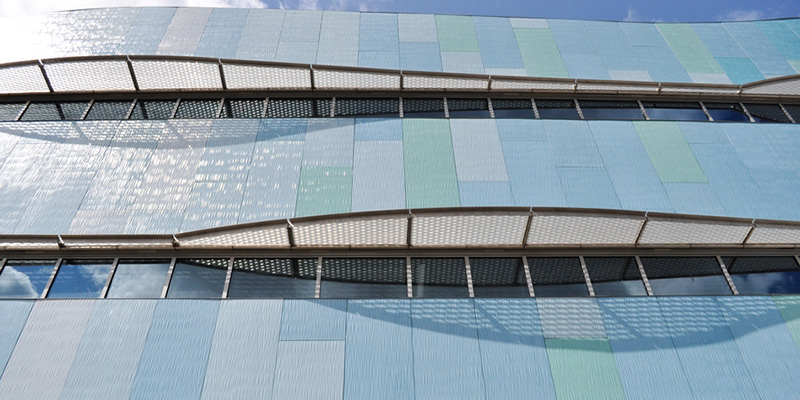
New buildings include RiverView Residence Hall (2008-9) and Cambridge Commons Residence Hall (2010). Also in 2010, UWM acquired the old Columbia-St. Mary’s Hospital, which would become the Northwest Quad complex, pursued its “Master Plan” involving major facilities to better support research and academic programs in need of space. Also, two new schools were approved for implementation, Public Health and Freshwater Sciences, and began hiring faculty and staff and developing new programs.
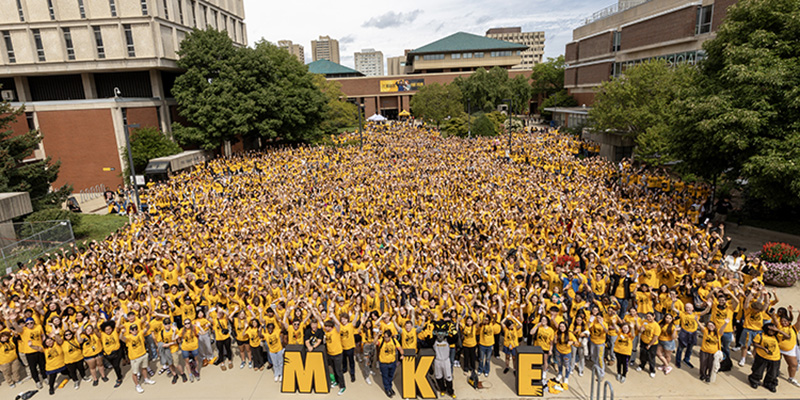
- Both student enrollment and the number of faculty remained high in 2008 at 29,265 and 798, respectively. UWM has grown to offer 32 doctoral, 53
master’s and 94 baccalaureate degree programs. - In 2009, the RFA established a listserv to assist in the rapid communication of important information to members with email accounts.
- During the 2009-10 academic year, the RFA developed its uwm.edu/uwmra website to share general RFA information, official documents, news items and important links.
- To facilitate internet communication, the executive committee established an
Internet Communications Committee, appointing Erika Sander to serve as chair. - At the May 2010 annual luncheon meeting, the RFA approved a series of amendments to its constitution to clarify areas of the organization’s charter.
- In the summer of 2010, Secretary-Treasurer Bill Mayrl worked with the UWM Foundation to set up RFA accounts for RFA membership dues, student scholarships and special projects.
- RFA membership grows to 383 and the RFA scholarship contribution increases to $2,000 per year.
- In May 2011, the RFA held a gala 50th Anniversary Luncheon.
2011-present
UWM’s campus continued to evolve with the notable additions of the Kenwood Interdisciplinary Research Complex (2015), the Lubar Entrepreneurship Center & UWM Welcome Center (2019) and the new Chemistry Building (2024).
- During the 2011-12 academic year, the RFA Executive Committee took under advisement the expansion of the current RFA to include all UWM retirees.
- In December of 2011, UWM approved a policy allowing retirees to retain their UWM ID card and to maintain their UWM email and internet access.
- In the Spring of 2012, a study reviewed other higher education institutions with retiree groups/associations. The majority were inclusive of all institutional retirees.
- In May 2012, at the annual RFA meeting/luncheon, the members approved opening up the RFA to all UWM retirees, effective immediately. The organization’s name was changed to the UWM Retirees Association (UWMRA).
- As of 2015, UWMRA had a broad-based Executive Committee representation from all employment ranks.
- The UWMRA has witnessed increases in membership. Programming and informational venues catered to UWM Retirees continue to evolve as interests dictate.
Bardell, Eunice Bonow (1986). The Retired Faculty Association of the University of Wisconsin-Milwaukee, 1961-1986. Milwaukee, Wisconsin, Unpublished monograph, UWM Golda Meir Libraries Archives, AC 126, Folder #3 (“History 1986”).
Information from 1986 to date was taken from various sources, including RFA Minutes, Annual “Newsletters/Directories,” financial reports and related material. These materials are located within the UWM Golda Meir Libraries Archives.