“Yuh Gotta Play Ball!” Chicago’s Surprising Yiddish Connection
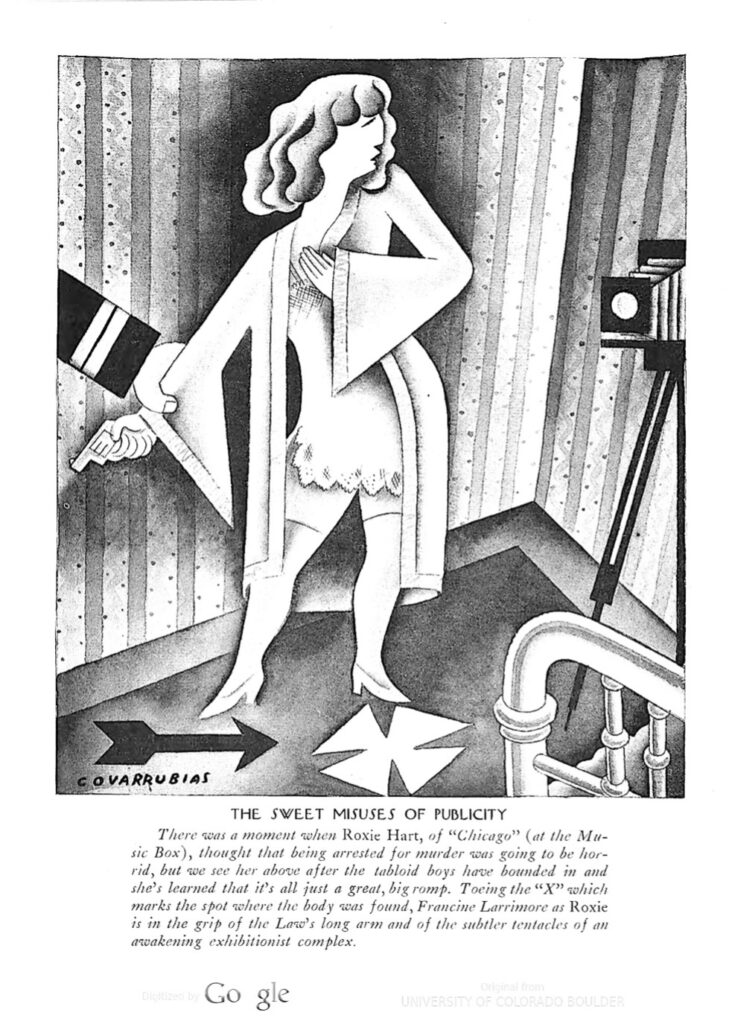
“Come on, sister, yuh gotta play ball: this is Chicago!” (Jake to Roxie – the final line of Chicago, a play by Maurine Dallas Watkins.)
Chicago, Chicago
Chicago, with music by John Kander and lyrics by Fred Ebb, is a two-billion-dollar enterprise according to Wikipedia.1 It enjoyed a very successful initial run of 936 performances on Broadway from 1975 to 1977 and was revived in 1996. Since then, Chicago has played continuously, making it the longest-running musical in Broadway theatrical history. There have been numerous productions of Chicago outside of New York City and its film adaptation (2002) won six Oscars including Best Picture.
Roxie Hart is the central character of a plot that “seeks to literalize the showbizification of American justice by performing it as a series of variety acts,” writes The New York Times drama critic Jesse Green.2 Roxie is jailed after shooting the man with whom she’s been carrying on an affair. Her cellmates include several other women who are likewise accused of murdering their lovers. When she goes on trial the courtroom theatrics of her celebrity lawyer Billy Flynn gets her acquitted. The musical concludes with Roxie and her former cellmate (and rival for attention) Velma Kelly performing together on a vaudeville stage.
Five decades before the musical there was the play on which it was based. Chicago’s original author was Maurine Dallas Watkins (1896-1969), who had been a courthouse reporter for the Chicago Tribune. It had its Broadway premiere at the Music Box Theatre on December 30, 1926. The New York Herald Tribune’s theatre critic described it as “a flighty panorama in burlesque… as jocular as a comic strip and almost as dramatic.”3 A small pit orchestra occasionally chimed in with renditions of “Yes, Sir, That’s My Baby” and—of course!—“Chicago, Chicago, that toddlin’ town.”
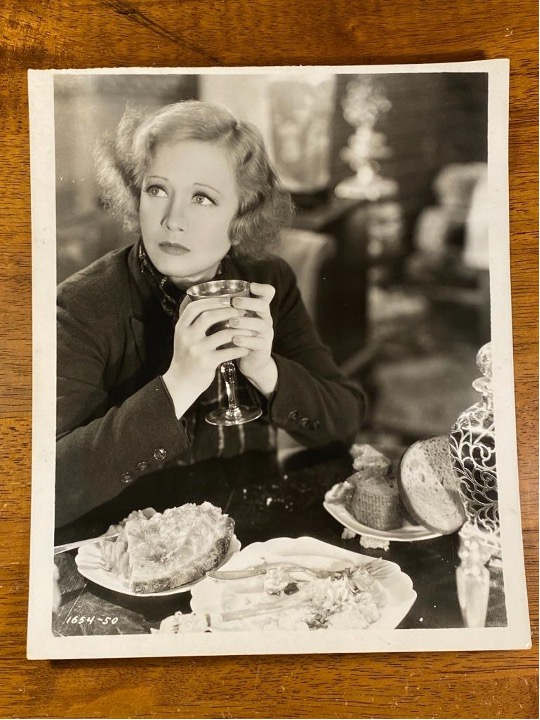
The original Roxie Hart was played by a “flapper comedian” named Francine Larrimore (1898?-1975). A newspaper columnist described her as “a wild, untamed, sensual, alluring Roxie, all sex appeal, quivering, alive—utterly unmoral. She is an animal out of a jungle. She is as conscienceless as a child.”4 The artist Miguel Covarrubias captured these qualities in his New Yorker caricature of Larrimore’s Roxie.
A different actress, Jeanne Eagels (1890-1929), had been cast in the role, but two weeks before opening night she stepped down, claiming “artistic differences” with its director, George Abbott. Larrimore was hastily drafted to perform in Eagels’s stead. No regrets or hard feelings; the Herald Tribune’s critic took note of the “contented expression on the face of Miss Jeanne Eagels” in the opening-night audience.5 Chicago enjoyed a respectable Broadway run of 172 performances, and the play then went on tour.
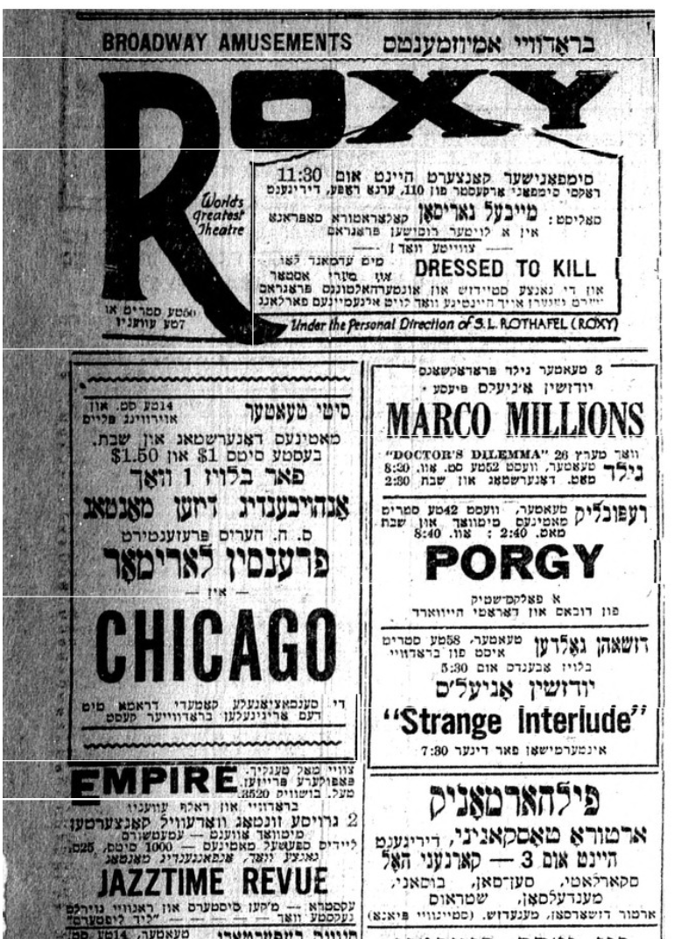
Roxie Hart: Jacob P. Adler’s Niece
What could that first production of Chicago possibly have to do with the Yiddish theatre? The answer: Its Roxie had an uncle named Jacob P. Adler.
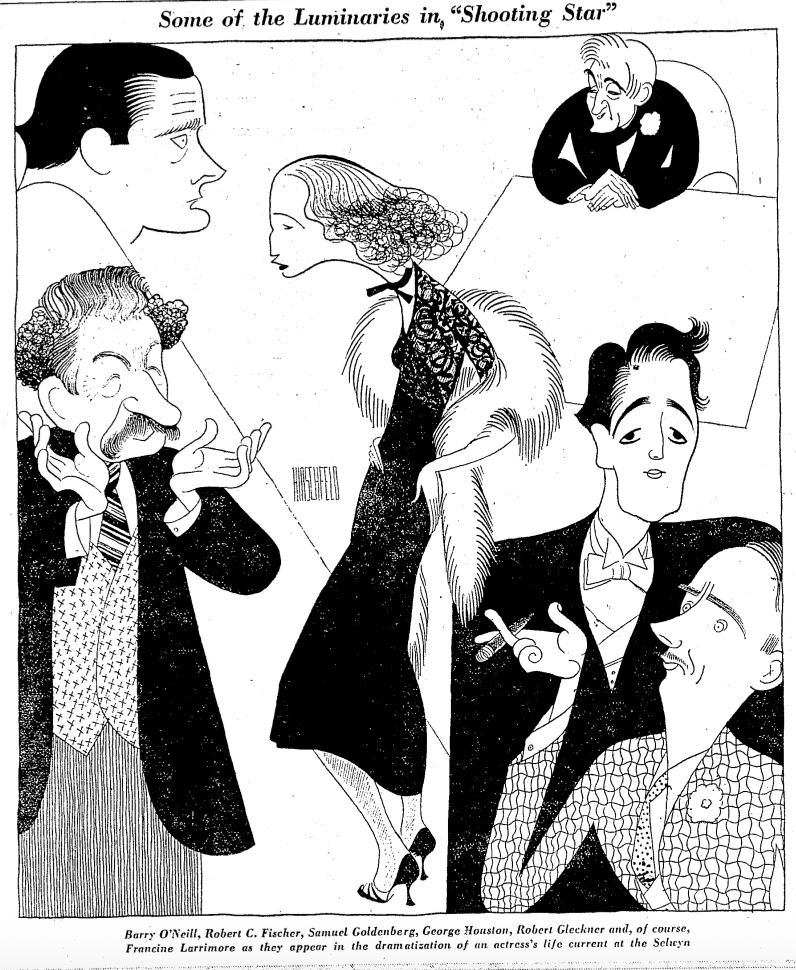
Francine Larrimore’s name cropped up while I was searching the Historical Jewish Press site for mentions of the Yiddish actor Samuel Goldenberg. Among the results was a review by Abraham Cahan of a Broadway play called Shooting Star, by Noel Pierce and Bernard C. Schoenfeld.6 Over the course of eleven scenes and three-and-a-half hours, it depicted the meteoric rise and fall of a fictionalized diva named Julie Leander. Francine Larrimore played Julie and Goldenberg was Herman Mordecai, an impresario of German-Jewish background inspired perhaps by Oscar Hammerstein (Senior) or Daniel Frohman. The caricaturist Al Hirschfeld produced a marvelous sketch of the cast. Shooting Star ran for just sixteen, un-air-conditioned performances in June 1933 before being taken down.
Cahan commented that despite Shooting Star’s clichéd plot, the play was a case of art imitating life. In it, Julie Leander succumbs to burnout and addiction after having starred in the same play for five years. Similarly, Jeanne Eagels had performed for four years in Rain, a play based on a story by Somerset Maugham, and in 1929 she died from a toxic mix of opiates and alcohol. There is of course a “meta” dimension to Shooting Star in that Larrimore was the very actress who had replaced Eagels as Roxie Hart in Chicago.
An Upper Crust “Yankee”
The Internet Broadway Database (IDBD) lists twenty-one Broadway plays from 1910 to 1934 in which Larrimore had roles.7 (She also performed in plays outside of New York City.) Her first major hit came in 1919, when she played Beatrix Vanderdyke in the three-act rom-com Scandal, by the English playwright and novelist Cosmo Hamilton (1870-1942). Before Scandal reached Broadway it had already played for six months in Chicago.
Beatrix is the “spoiled daughter of a wealthy family longing for adventure in Bohemian atmosphere.” When her anxious parents track down Beatrix at an artist’s studio, she informs them (falsely) that she has eloped with one of the artist’s friends, Pelham Franklin (played by the English actor Charles Cherry [1872-1931]). This revelation is followed by a mock honeymoon, which begins with Beatrix and Pelham at each other’s throats and concludes (predictably) with “the couple in each other’s arms at the final curtain.” Though some newspaper critics complained that it was “too talky in parts,” they praised Larrimore’s and Cherry’s performances.8 Scandal ran for more than 300 performances on Broadway.
A few years later Hamilton reflected upon Scandal’s success:
It did not seem to me that Francine Larrimore was suited to the part of the young autocrat… The manager [Walter Hast (1876-1945)] and all the members of his loving family argued with me at once, and while I sent people to scour New York to find another actress, Miss Larrimore clung to the part with so fine a courage and so clamlike a determination that the atmosphere of the empty theatre became charged with emotion.
Eventually, Hamilton was worn down by the sheer force of Larrimore’s insistence and then he was persuaded by her convincing performance:
Her belief in herself as the exponent of Beatrix Vanderdyke was more than justified by the extraordinary success that she achieved… With a rare combination of comedy and tragedy, Miss Larrimore is a young actress of genius who will, in a better part than that of the girl in Scandal, jump to the very top of the dramatic tree.9
In 1924 she starred in another play by Hamilton, Parasites.
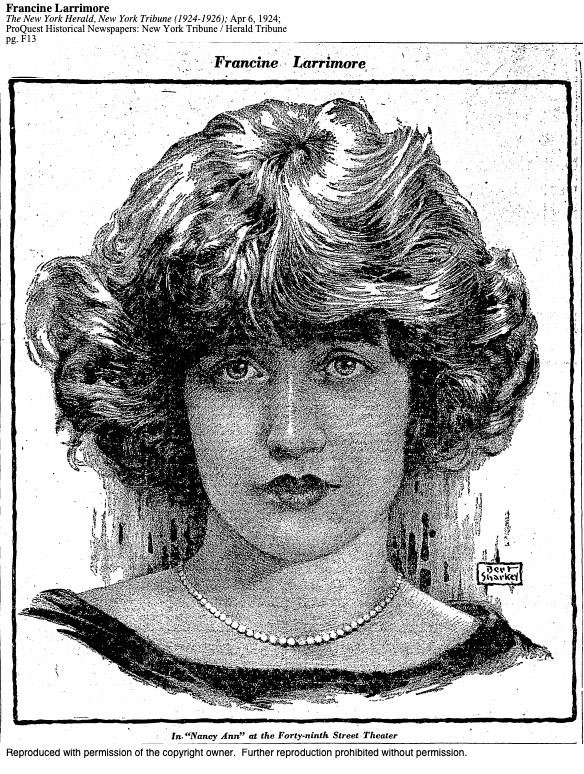
Larrimore was often typecast in upper crust “Yankee” roles in middlebrow “boulevard dramas,” including at least three works by prominent women authors. These included the title role in Nancy Ann (1924), by Dorothy Heyward (1890-196110), and two plays by Rachel Crothers (1878-1958), Nice People (1921) and Let Us Be Gay (1929), a hit that enjoyed a run of 132 performances on Broadway and then went on tour. In Nice People Larrimore shared the stage with two young actresses who went on to illustrious careers, Katharine Cornell and Tallulah Bankhead. Let Us Be Gay was a drawing-room comedy involving a divorced couple that is brought together again. Brooks Atkinson, in The New York Times, praised Larrimore’s performance in that play while drawing attention to her elocution: “As the Lorelei of Westchester and Manhattan, Francine Larrimore gives the most supple character interpretation in her career. Her diction is slovenly and her voice uncontrolled. Her acting, however, has a new fluency.”11 In 1931, as her theatrical career was beginning to wind down, she was upstaged by the loquacious Alexander Woollcott (1887-1943), her co-star in Brief Moment, by S. N. Behrman (1893-1973).
Just Be Yourself
Francine Larrimore was petite (five feet, one inch), with flaming auburn hair. She delivered her lines in a husky, “freakish” contralto which reviewers considered either off-putting or captivating (or both). In the mid-1920s the future screenwriter Wells Root wrote: “Miss Larrimore probably omits more syllables than any other actress that ever made herself quite audible across the footlights. She slouches. Her face and hands are constantly in nervous motion. Yet she has some power of personality, some vocal note that carries its appeal.”12 The critic George Jean Nathan defended Larrimore’s unconventional delivery:
Heavily criticized for the peculiar hoarseness of her speaking voice, it will be well for her to rest assured that this peculiar hoarseness is one of her most valuable assets, and that for her to lose it would be a distinct loss to her individuality. The studiously acquired and artificial mellifluous speaking voice is one of the banes of the American stage… There are altogether too many second-hand Ethel Barrymore voices as it is.13
John Bassett, the author of a recent biography of the playwright Rachel Crothers, considers Larrimore’s seemingly casual vocal technique to have been an effective dramatic tool. She “was especially engaging for her dexterity in using her voice in creative ways for emotional impact,” he writes.14
For her part, Larrimore defended what critics perceived as “a cyclonic, turbulent method of acting”:
I really believe… that the stage has spoiled the ability to be natural… Very few persons I know begin a sentence and see it through to a successful termination. Our thoughts skip too quickly for the tongue to master them… In my performance [in Parasites] I attempt to catch that quality… I want to be natural and in so doing I slur words, I falter, I hesitate—just as I do when I ordinarily talk. If this be injustice to dramatic art—make the most of it.15
Yet, Larrimore would scarcely have described herself a “Method” actor had this label been au courant in her heyday. By 1929 she insisted that she left her roles behind at the stage door:
Naturally, a certain amount of resistance is necessary to keep one from going stale in a part played for many months. One of the surest ways to wear the edge off is to live a part twenty-four hours each day… When I step on the stage, I become Kitty Brown [in Let Us Be Gay], but Francine Larrimore rides home with me—not Kitty Brown—and that makes all the difference in the world.
Rather than follow Jeanne Eagels’s example and remain for years in a hit play, Larrimore consistently elected to move on to the next project rather than go “stale.”16
In a successful attempt to demonstrate that she really did possess dramatic range, Larrimore held her own in This Was a Man, by Noël Coward (1899-1973). The Herald Tribune’s critic praised her, though with a whiff of condescension: “Surrounded by a company of British artists to the manner born, she vied with them in elegance of diction and grace of movement, proving perhaps that it is not too far from upper Riverside Drive to Mayfair.”17 It was in the middle of that run that she was tapped for Chicago, where her representation of Roxie was in an altogether different register.
In addition to her acting, Larrimore displayed a flair for costumes. Starting as early as 1912, newspapers and magazines often published photographs of her in the frocks and gowns that she wore on stage. And then there was her aptitude for set design. As a New York Tribune reporter wrote: “When she was playing in ‘Scandal’ she helped decorate and design some of the sets, and she planned the interior decorating scheme of the bedroom and actually made most of the pillows and hangings that were used.”18 The playwright Cosmo Hamilton confirmed this in his reminiscences concerning that production.
The Roaring Twenties and Beyond
Francine Larrimore’s life offstage during those years might provide worthwhile fodder for a play or movie about a star actress during the Roaring Twenties. When the Volstead Act prohibiting the manufacture and sale of alcoholic beverages took effect, the Herald Tribune revealed that Larrimore intended to set up an “aerial nest” on her Riverside Drive building’s rooftop where she promised to “serve things that you cannot get in restaurants.” Invoking the Deity, she stated: “God will be the only one to see us and He will not object… Didn’t He make the rye, the grapes and the other things? Why should He object, then?”19
A few years later, the Herald Tribune reported on “hotel revelry” in Atlantic City and New York, led by Charles R. Forbes, the scandal-ridden director of the federal Veterans Bureau. “The Larrimore girls, sisters,” partied there together with Forbes, a building contractor named J. W. Thompson, and Thompson’s agent Elias H. Mortimer and his wife. A clerk with the Veterans Bureau, McGill Connor, testifying at Forbes’s conspiracy trial in mid-December 1924, recalled these hijinks more than two years after they had occurred. Connor averred that a craps game at the New York hotel had been organized by Mrs. Mortimer. It “lasted fifteen or twenty minutes,” following which “the party continued for some hours” and “a general, social good time” was had by all.20
Then there was the sensational burglary on January 13, 1924, at Larrimore’s apartment on Fifth Avenue near 50th Street. The Broadway star “was at her mother’s apartment, at 730 Riverside Drive,” when the heist took place. “Her maid was out for the day. She did not return until nearly midnight, and entered to find the place turned topsy-turvy and her jewels, valued at $25,000, missing.” Total losses (also including clothing and furnishings) amounted to $30,000 – the equivalent of over half a million dollars in 2026. At Larrimore’s request, the theft was kept secret for over a month.21
In early 1930, during the tour of Let Us Be Gay, Larrimore was kept “constantly under guard of two Chicago detectives after “racketeers” threatened “to take Miss Larrimore ‘for a ride’” and “extort $25,000 from the actress.” She had “received a letter… informing her that hundreds of World War veterans were in distress in Chicago and saying that she had been put down for a $1,000 contribution.” A few days later a telephone caller informed “her that the ‘ante’ had been raised to $25,000 and that unless she paid it she would be kidnapped.”22
This incident led The New York Times to run a mordant editorial riffing on the Windy City’s shady reputation. It seems that “the persons who attempted various hold-ups of Miss Francine Larrimore, [the actor] Mr. Charles Winninger and Mr. Groucho Marx were small fry” in the eyes of “Chicago’s eminent gang leaders… They expressed formal indignation that these trifling demonstrations should have been connected with the real gangs of the city.” One “renowned [gang] leader suggested that if Miss Larrimore would dine with him in public it would be sufficient notice to the jackals that the lion would stand for no poaching.” The upshot, per the Times editorialist: “The stage and all the artistic elements of the nation will note with appreciation what Chicago’s responsible gangsters have done.”23
For about three years in the 1920s, Francine Larrimore maintained a stealth marriage to the songwriter Con Conrad (né Conrad Dober). He is remembered for his lyrics to such popular songs of the era as “Barney Google” and “Lena from Palesteena.”24 The couple lived apart during much of that period, keeping their relationship secret from their closest friends and relatives for the first eighteen months of the marriage. There was a separation followed by a reconciliation which blew up on April 30, 1925.
That was when Francine, suspecting Conrad of carrying on an affair, organized a raid at the Hotel Claridge, near Times Square. Joined there by her sister Stella, their brother Louis Adler, and a friend of Louis, they “identified Dober’s handwriting in the hotel register in which he had made the entry, ‘Mr. and Mrs. Charles Gorman.’ Going to the room indicated alongside the names, the raiders discovered Mr. Dober, claid [sic] in pajamas. Searching further, they found a blonde young woman hiding in a closet.” Larrimore’s lawsuit was uncontested at the divorce trial, which took place on October 9th of that same year. Having been caught in flagrante delicto, “Mr. Dober failed to appear to defend the suit,” the Herald Tribune’s reporter laconically observed.25
Larrimore’s summertime crossings to and from London and Paris were duly recorded by New York’s newspapers of record. Her personal papers include a souvenir program from the Royal Ascot races and a printed menu for her birthday celebration at the Savoy, in London (both, 1937). Since she did not become a U.S. citizen until 1935, one wonders what kind of travel documents she presented to officials at her ports of call until that juncture. First-class passengers like her may have been granted absolution by customs officers.
Just Who Was Francine Larrimore?
“A French-born New Yorker and sister of the great Yiddish singer Jacob Astor…”—this is how John Bassett introduces our heroine in his biography of Rachel Crothers.26 The phrase encapsulates the Yiddish saying “Noyekh mit zibn grayzn,” wherein the biblical figure Noah’s two-letter Hebrew name נח impossibly contains no fewer than seven spelling errors.
“French-born”? We’ll get to that.
“Jacob Astor”? This sounds like something out of a Mel Brooks script. (Beaver pelts, anyone?)
Astor’s “sister”? No, she was Jacob P. Adler’s niece.
“The great Yiddish singer”? Adler disclaimed any talents or aspirations in this direction. He was a dramatic actor, not a singer (in contrast, say, to his colleague and sometime rival Boris Thomashefsky).
Depending on who you believe, Francine Larrimore was either born in Odessa or in Verdun, France. Her father was either a Russian-Jewish dry-goods merchant named Isaac Levovsky (or possibly Leibowitch) or a Frenchman named J. Louis La Remée (or possibly Larimee). She claimed that she was born in 1898, though circumstantial evidence suggests that she was born a few years earlier.
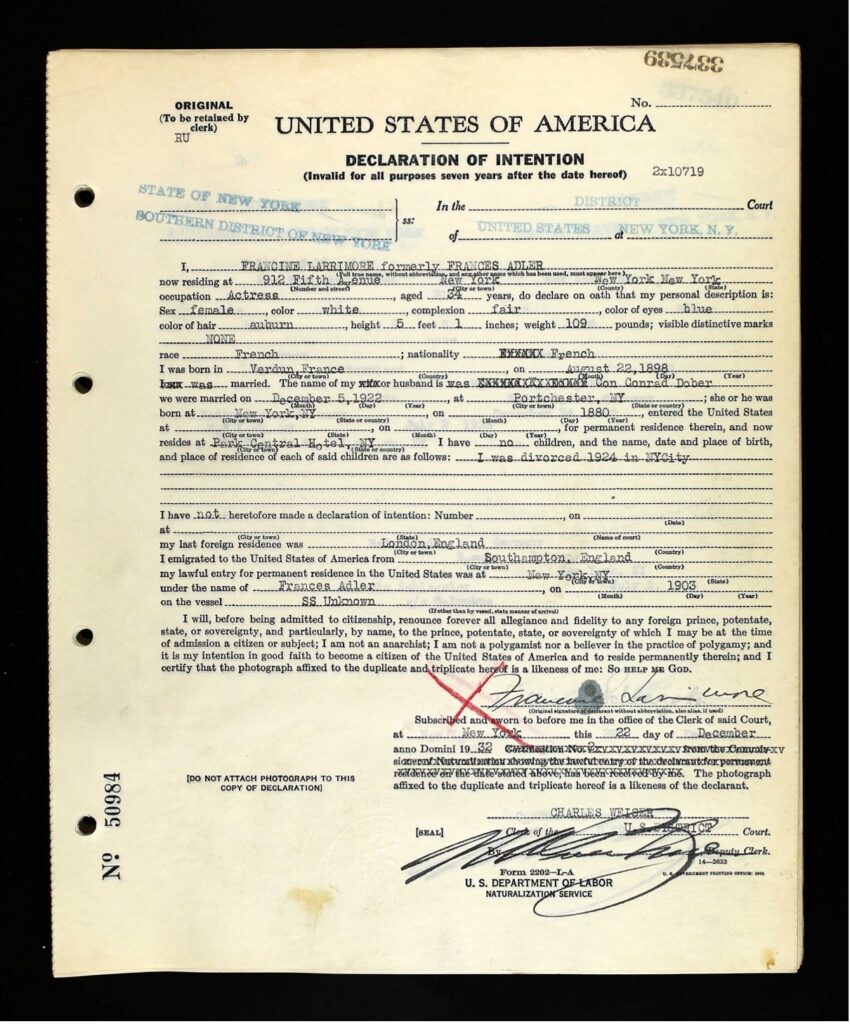
Larrimore’s Declaration of Intention for naturalization (filed in December 1932) states that she emigrated from Southampton, England, in 1903, on the “SS Unknown,” under the name Frances Adler—her legal name in the US.27 In her Petition for Citizenship (filed in May 1935) she affirmed that she had resided continuously in New York City since May 1903, when she was (supposedly) not quite five years old. In both documents she stated that she was born in Verdun, France, on August 22, 1898, and that her nationality was French.28 Some of these details are debatable, to say the least.
Jacob P. Adler’s granddaughter Lulla Adler Rosenfeld wrote that Francine’s family hailed from Odessa, not France, and she referred to Fanya—the future Francine—as one of her “pretty Russian cousins.” Adler visited his younger sister Sara (or Soore) and family—including Fanya—in Odessa sometime after 1900. According to Lulla Rosenfeld, this trip took place following the Kishinev pogrom (April 1903). “He intended to bring his family back with him to America,” she wrote. “He found his sister married and with a brood of children, all in a state of excitement about their famous uncle from America.”29 As Larrimore’s grand-nephew Eric Brown remarked in a 2014 blog post: “Jacob Adler’s sister Sara… had remained in Russia after most Jews fled the persecution of the Russian pale.”30
However, according to public records available online, Adler had traveled to Europe a couple of years earlier, in the summer of 1901.31 So, if Francine and her family were already in New York City by May 1903 (as she claimed in her Petition for Citizenship) there would have been no further need for Adler to travel to Odessa.32
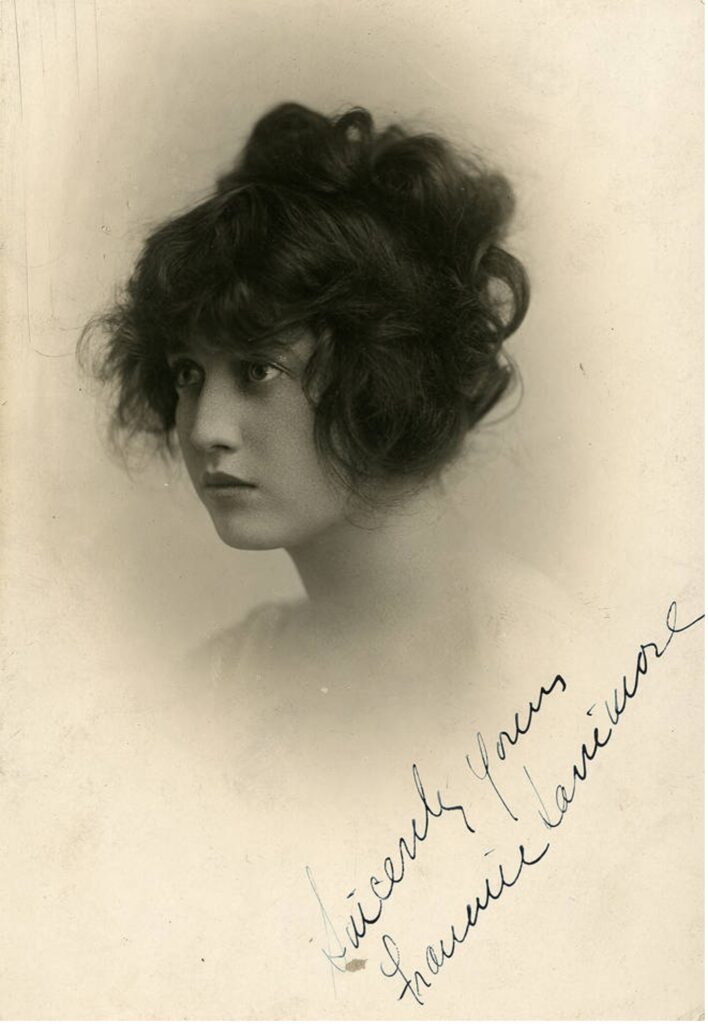
Francine Larrimore, photographed by C. Bennette Moore, New Orleans, 1912. She was playing in the touring company of Over Night, by Philip Bartholomae. (Source: Wikimedia Commons.)
Part of Larrimore’s self-reinvention involved re-situating her birthplace from the Black Sea port city to a relatively obscure town in northeastern France where one of the Great War’s bloodiest battles had been fought. In so doing, Larrimore’s purported Franco-American identity became part of her act. Nevertheless, it was hard to reconcile this with the universally acknowledged fact that she was the niece of a famous Yiddish actor from Odessa.
Did She Fudge Her Age?
The likely distortion in Francine Larrimore’s biography concerning her birthdate is less surprising, given that this is a common practice in show business and elsewhere. Abraham Cahan, in his dual roles as Yiddish newspaper editor and occasional theatre critic, was certainly aware of Jacob Adler’s familial ties. In his review of Shooting Star, he wrote that Larrimore was about ten years old when she came to the US.33 Had she been born in August 1898 (as she asserted) and then immigrated at the age of ten (per Cahan), that would place her arrival in the US as late as 1908. However, Larrimore must have immigrated several years earlier, given that she made her Broadway debut in February 1910. By then she would have resumed her education in New York’s public schools and the future Hunter College High School.
Lulla Rosenfeld recalled that once “the whole brood of pretty ‘Russian cousins’ had come to America” they “were always in” Jacob and Sara Adler’s spacious apartment.34 Francine’s mother discouraged Larrimore from pursuing a career on the stage, possibly because of her firsthand exposure to the Adler household. As Eric Brown observed, “A rift between the two sides of the family ensued as the bohemian, theatrical Jacob and his children didn’t mix with the ‘conservative,’ other half of the family who went into retail.”35 It was only after graduating high school that Francine “finally gain[ed] her mother’s consent.”36
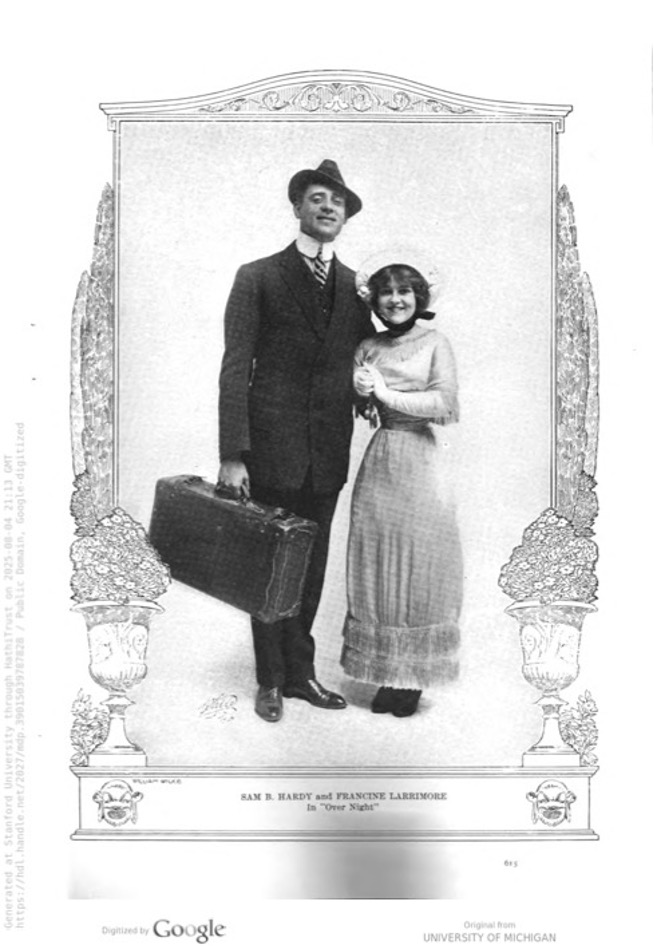
A newspaper profile from the mid-1930s stated that Larrimore “was but fifteen years old” when she first went on stage. This was echoed in the program brochure for The Temporary Mrs. Smith (1946): “At the age of fifteen, she was given the chance to play the leading part in a touring company of ‘Overnight,’” a popular play by Philip Bartholomae (1880-1947).37 However, in an interview published much earlier, at the time of her breakthrough in Parasites (1920), Larrimore stated that she cast her lot with the theatre when she dropped out of “normal college” as an undergraduate.38 This chronology was substantiated by a brief profile in The Hebrew Standard in April 1921: “Miss Larrimore graduated from High School, and some eight years ago, while attending a normal school preparatory to becoming a teacher, was offered a small part in ‘Over Night.’”39 She would presumably have been around seventeen at the time.
Larrimore appeared in Over Night during the course of 1912—two years after her Broadway debut—performing in venues across the country. In other words, if she was indeed fifteen at the time she would have been born in 1897, not 1898 (as she later claimed). But given her mother’s reservations concerning Francine’s chosen profession I question whether she would have been permitted to join a traveling ensemble even at that age—playing a young bride, no less! (Though I’m open to persuasion regarding this point.) Rather, I’m inclined to believe that the future Francine Larrimore was born circa 1895, immigrated with her family in 1903 or thereabouts, and graduated high school around 1911 or 1912.
The Name Larrimore
The paternal surname La Remée is almost certainly a made-in-USA invention.40 It doesn’t seem to derive from an actual word in the French language. Be that as it may, Isaac and Sara’s children bore the maternal surname Adler in America. Because Francine shared her legal name, Frances Adler, with an actress cousin, she adopted a different stage name.
Where, then, did the name Larrimore come from? In his review of Shooting Star, Abraham Cahan wrote that she had picked the name out of a novel. But according to a photo caption in Eric Brown’s blog post about his great aunt, “Larrimore was a name taken from a Lexington Avenue drugstore.”41 Oddly enough, there might actually be some truth to that claim: the 1910-11 New York City Directory lists two Dudley Larimore (just one “r”) & Co. pharmacies in midtown Manhattan, with locations at 1 West 46th Street and 511 Madison Avenue.42 Of course, it didn’t hurt that “Larrimore” rhymes with Barrymore, the name of a celebrated American show-biz dynasty. (Years later, did she work backwards from that to come up with the faux-French La Remée as her father’s supposed last name?)
Larrimore and the Adlers
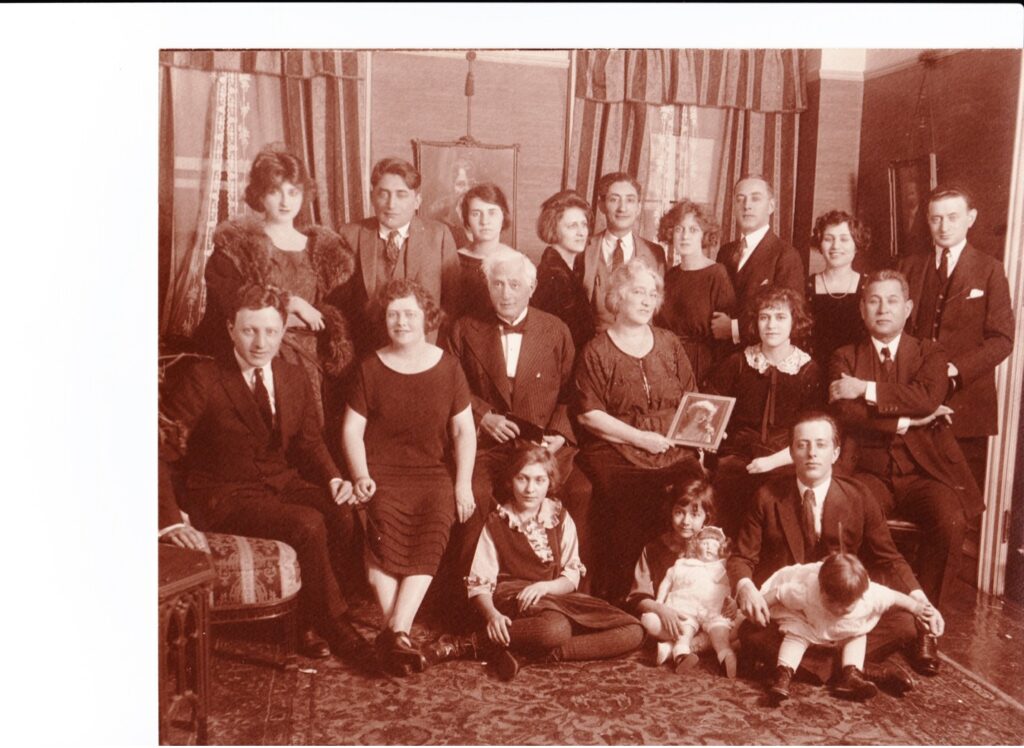
There is a group photograph of the Adler family that was taken some time in the 1920s. Seated at center is the family patriarch, Jacob P. Adler. Next to him is his sister Sara, proudly displaying a small, framed photograph of her famous daughter Francine, who however is not present in person. Among the nineteen Adlers and their spouses and children are two Stellas: Jacob’s daughter and Francine’s younger sister, both of them actresses. Stella Adler later achieved great renown as a teacher of actors; Stella Larrimore’s career on stage was brief—though it did lead to her marriage to the actor Robert Warwick, who had once co-starred alongside Francine. Albert, Louis, and Paul Adler are also in the picture, as is their unnamed father (Sara’s husband). “He was so incidental,” Eric Brown remarked, “that even on his deathbed… he was relegated to a cot in the dining room so as not to inconvenience Sara.”43 The family regarded Sara’s husband—Francine’s father—as something of a nebbish.
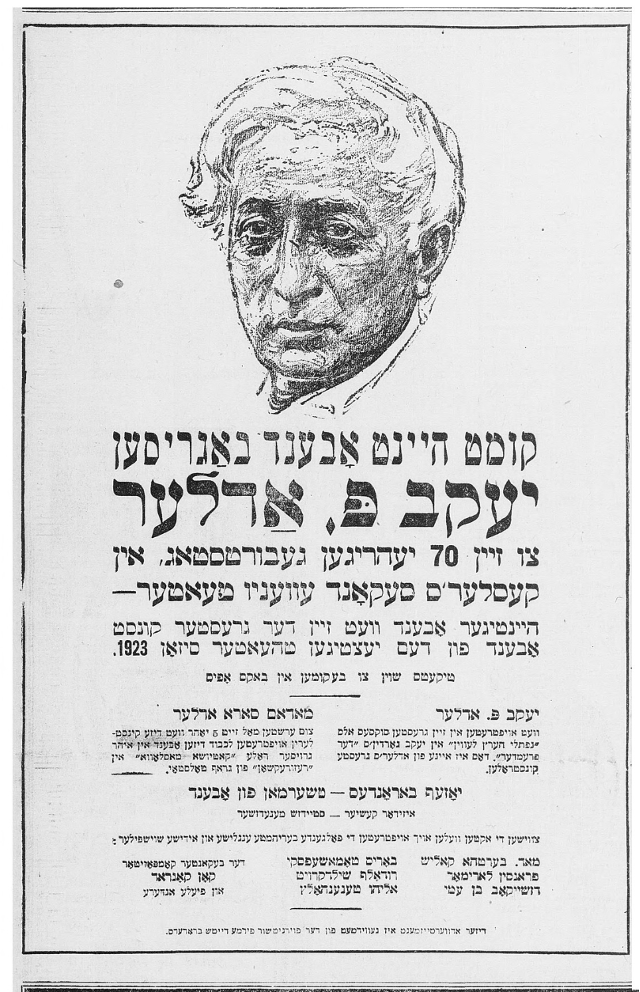
Francine’s American-born nephews and nieces called her Aunt Tween, but to members of her famous uncle’s generation she remained Fanya, the “prettiest of the ‘little Russian cousins’.”44 She lent her presence to at least four of Jacob P. Adler’s farewell appearances—five, if you count his funeral. First, there was the benefit on December 4, 1922, at Gabel’s 116th Street Theatre, where Adler performed his “immortal success” as Dovid Moisheles in the Jacob Gordin play The Jewish King Lear. During intermission “the great American actress” Francine Larrimore paid tribute to her uncle. She was joined on stage by Ludwig Satz, Clara Cherniavsky (Satz’s piano accompanist), and Maurice Schwartz.45
Next came the benefit on February 8, 1923, celebrating Adler’s seventieth birthday, when Larrimore and Con Conrad (to whom she was secretly married at the time) and others rendered homage to the “Great Eagle.”46 (What might Conrad have contributed to that event – a rendition of “Lena from Palesteena,” maybe?) Another benefit performance honoring the ailing Adler was held on March 16, 1923, with Larrimore and several other actors again stepping out on stage between the acts.47 Then, on February 9, 1926 (less than two months before Adler’s death), “the great American actress Francine Larrimore” joined a constellation of stars at Kessler’s Second Avenue Theatre, in a matinee honoring “the king of the Yiddish stage.”48 These appear to be the only occasions in Larrimore’s professional career when she graced the stages of Yiddish theatres, though her presence there was as an “American actress”—and the honoree’s niece.
And finally, New York’s English-language dailies noted her attendance at Adler’s funeral on April 1, 1926.49 Apart from these occasions, Larrimore kept her distance from the Yiddish theatre. The detailed inventory of her personal papers does not list the names of any Yiddish actors or directors—Adlers included (!).50 Her social connections resembled those of the comfortably well-off WASP-y characters that she often portrayed on stage.
Fadeout
After Shooting Star, Larrimore appeared in just one more Broadway play, in October 1934. It was her only Jewish role, Florrie Solomon, in Spring Song, by the screen- and play-writing couple Bella and Samuel Spewack. The cast of Spring Song included several veterans of the Yiddish theatre.51 Larrimore’s character was “a lowly belle of the Ghetto” as the Herald Tribune’s acerbic theatre critic put it. “She was an irritating brat, wheedling, snarling, mumbling and shrieking accurately throughout the evening…”52 Abraham Cahan’s Forverts review of Spring Song offered a more charitable spin. He praised the play as “a genuine drama, strong and realistic in the true sense of the word.” As for Francine Larrimore, “She performs this role strongly and she meets with success once again.”53 Brief scenes from Spring Song were broadcast on the New York radio station WEVD during the play’s Broadway run.54
However, Larrimore’s career on the Broadway stage was finished, a casualty of the Depression and professional burnout. “It is hard work, nothing but hard, relentless work,” she complained during Spring Song’s run. A decade earlier she had gloried in the little adjustments that she made to each of her performances. But by 1934 she lamented that “perhaps the most bitter thing of all… is that we have to start every evening all over again, practically from scratch. One stands always before a new case, a new problem, and has to succeed, or one fails completely and all former successes are forgotten. The public is pitiless and has a short memory.”55 Larrimore had evidently wearied of what her famous uncle called the actor’s “everlasting duel with the public.”56
After Spring Song, Larrimore occasionally acted in tryout productions on “out-of-town” stages, and she accepted guest spots on the radio. There were hints of returns to Broadway that never actually panned out. In 1935, the producer Irving Thalberg signed her with MGM, but her Hollywood career was brief and forgettable. Her social engagements were occasionally mentioned by gossip columnists in trade publications, as was the fancy car that she drove “around town with her nose bobbed – looks like a cross between Miriam Hopkins and Helen Mencken [sic].”57 (This possibly alluded to Hopkins’s wholesome good looks which were often enhanced by her bleached-blond hair, and Menken’s semi-parabolic nasal profile.)

MGM was unable to find a suitable vehicle for Larrimore’s talents, so she was loaned out to Paramount, which cast her alongside Edward Arnold in a second-tier feature film, John Meade’s Woman. It opened to mixed reviews in 1937.58 Two years later Larrimore had uncredited part as an “Island Girl” in The Devil’s Daughter, a short feature that was set in Jamaica. That was the sum total of her involvement with the talkies (she had appeared in a few silent shorts between 1915 and 1917).
The factors that formerly made Larrimore such a success on the theatre stage probably worked against her on the soundstage. These included the stop-and-start regimen in front of the camera and the absence of a live audience. In addition, her diminutive stature, the “haunting timbre” of her voice, and her (by Hollywood standards) advanced age were barriers to success on the silver screen. A first-time movie actress who was pushing forty wasn’t about to be cast in the carefree romantic roles and screwball comedies that had been her Broadway trademarks back in the 1920s.
During World War II, Larrimore completed a Motor Mechanics course, and she served as a hostess at the Stage Door Canteen in the Broadway theatre district, an entertainment venue for soldiers and sailors that was organized by producers and stage personalities. A year after the war ended, she attempted a comeback in The Temporary Mrs. Smith, a comedy by Jacqueline Susann (future author of the best-selling novel Valley of the Dolls) and Beatrice Cole. Larrimore bailed after the tryout performances in Wilmington, Delaware, and the play never made it to Broadway.59 That marked the end of her acting career.
Francine Larrimore lived on for almost three decades after that and she remarried late in life. (Her second husband was Alfred T. Mannon [1897-1972], who had produced and directed a few films in the 1930s.60) The inventory of her papers offers very few hints regarding her activities during her extended retirement. Every now and again her name was mentioned in passing by a later generation of journalists who remembered her from performances they had seen when they were young.
Why English (and not Yiddish)?
In the late nineteenth and early twentieth centuries, quite a few Yiddish actors were either American-born or immigrated when they were children. The constant influx of new immigrants, the immersive environment of Jewish neighborhoods, the continuing popularity of the Yiddish theatre, and (in some cases) family ties with theatrical dynasties provided the conditions that made it appealing for some younger Jewish actors to choose Yiddish.
In a 1962 article in Variety about the decline of the Yiddish theatre in America, the journalist Wolfe Kaufman identified Francine’s American-born cousin Celia Adler as a stage actor who had performed in both Yiddish and English. In contrast, Kaufman inaccurately wrote, “other members of the fabulous Adler family—Stella Adler, Luther Adler, Francine Larrimore, et al., were strictly Broadway.”61 Several of Jacob Adler’s offspring, including Stella and Luther, cut their teeth on the Yiddish stage. That said, Stella admired her cousin for “successfully mak[ing] the leap to Broadway before [she] and her siblings” did so.62
Young Fanya grew up surrounded by Russian and Yiddish speakers. Conceivably, her primary language in Odessa was Russian rather than Yiddish. At any rate, after she came to America this niece of Jacob P. Adler concluded that her future stage career had to be in English. She evidently had an excellent ear for the language, accents and all. Yet this quintessentially American actress did not even become a US citizen until 1935.63
Chicago Redux
Today, Francine Larrimore is remembered—if at all—for just one role: Roxie Hart, in Chicago. Though the play had a respectable run it was far from her biggest hit. Three decades later Gwen Verdon began to explore possibilities of a musical adaptation. At the time she was starring in Damn Yankees, whose director and co-author, George Abbott, had (coincidentally or not) directed the play Chicago in 1926. The Herald Tribune’s reporter felt it necessary to remind his mid-1950s readers that Chicago was “the satirical comedy in which Francine Larrimore appeared on Broadway in 1926.” An outline of a musical tentatively titled Roxie Hart was said to be in preparation. The Trib’s reporter described it as a long-term project.64
Long term indeed! It would take nearly two more decades for the Kander-Ebb musical to reach the stage. During the 1960s the Broadway director and choreographer Bob Fosse unsuccessfully attempted to obtain the rights from the play’s author, Maurine Watkins. It was only after her death in 1969 that Fosse acquired the script.65 Sadly, the very first Roxie Hart—Francine Larrimore—was not present at the Broadway premiere of the musical Chicago on June 3, 1975. She had died on March 7th at the ostensible age of seventy-seven.66
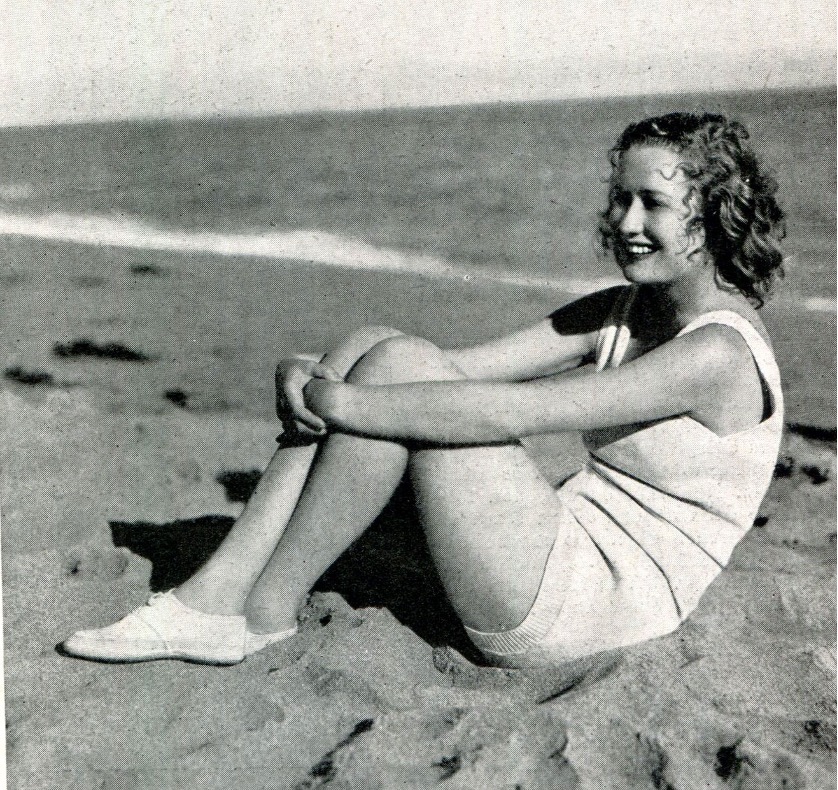
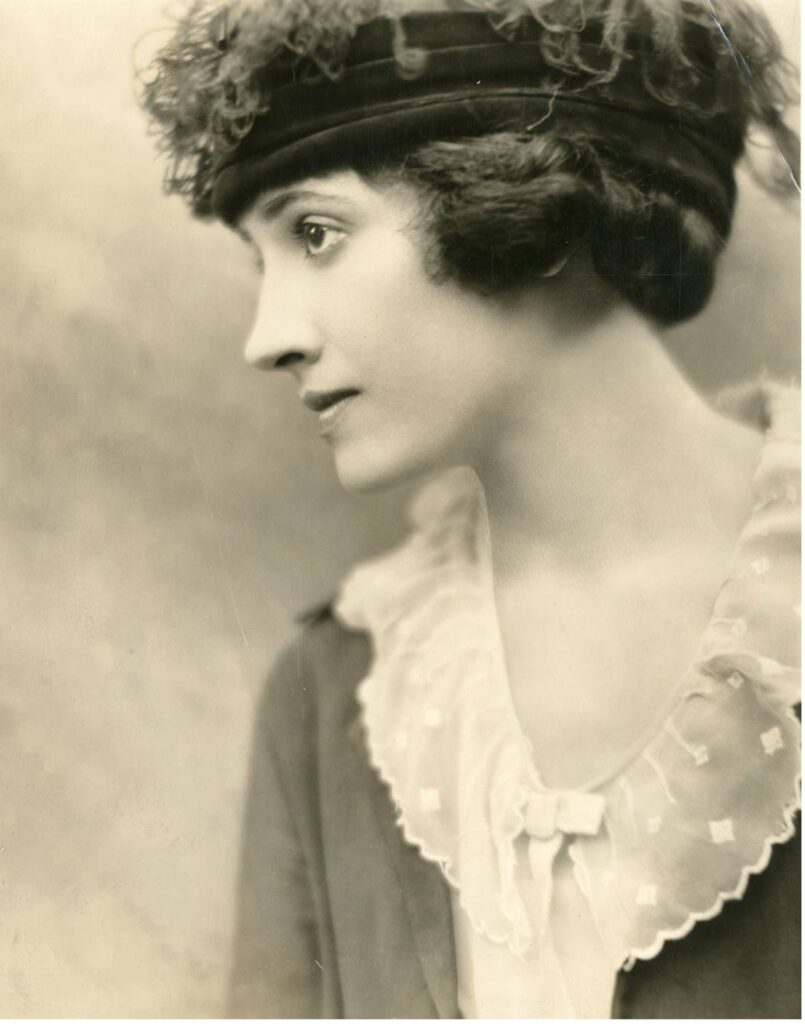
Postscript: Larrimore in Laramie
Shortly after her death Larrimore’s brothers Louis and Paul Adler donated her archives to the American Heritage Center at the University of Wyoming. This might seem an improbable resting place for the personal papers of a Broadway star; surely The New York Public Library for the Performing Arts would have been a more logical repository. A web page on the AHC does list “Hollywood and the history of the entertainment industry” among its collections’ strengths. For example, papers of such Hollywood personalities as Anne Baxter, Jack Benny, and Barbara Stanwyck are found there.67 Nevertheless, the AHC’s main focus is on the American West, and not the Great White Way. The University of Wyoming’s location in Laramie may well explain the family’s decision to place the archives of Francine Larrimore—daughter of the supposed J. Louis La Remée / Larimee in its American Heritage Center.
Appendix: Personalities mentioned in this essay.
George Abbott (1887-1995): Legendary director, producer, and writer for the stage and screen, with a career spanning eight decades. Abbott was the director of Chicago during the play’s 1926-1927 run.
Jacob P. Adler (1855-1926): “Ha-nesher ha-godol”—The Great Eagle, a towering dramatic actor in the Yiddish theatre. His sister Sara (not to be confused with his actress wife, also named Sara) was Francine Larrimore’s mother.
Stella Adler (1901-1992): Daughter of Jacob and Sara Adler. She acted in both Yiddish and English, and then ran the famous Stella Adler School of Acting.
Edward Arnold (1890-1956): Prominent screen actor during Hollywood’s “Golden Age.” He was Francine Larrimore’s co-star in the Paramount movie John Meade’s Woman (1937).
Tallulah Bankhead (1902-1968): Legendary actress on the New York and London stages, with notable successes in Hollywood as well. She co-starred with Francine Larrimore in Nice People (1921), by Rachel Crothers.
Philip Bartholomae (1880-1947): American playwright, director, and screenwriter. Francine Larrimore was in the touring company (1912) of his first successful play, Over Night, after its Broadway run (1911).
S. N. (Samuel Nathaniel) Behrman (1893-1973): American playwright, screenwriter, and regular contributor to The New Yorker. Francine Larrimore was in his 1931 play Brief Moment, where she was upstaged by her co-star Alexander Woollcott.
Maurice S. Campbell (1869 or 1870-1942): Journalist and Broadway producer; author/adapter of the play Where There’s a Will (1910), in which Francine Larrimore made her professional stage debut when she was probably fifteen.
Charles Cherry (1872-1931): British-born actor; he played opposite Francine Larrimore in her first hit on Broadway, Scandal (1920), by Cosmo Hamilton.
Con Conrad (Conrad Dober, 1891-1938): American songwriter, author of “Lena from Palesteena,” “Singin’ the Blues,” “Barney Google,” and other popular songs. He and Francine Larrimore were secretly married in 1922; they divorced in 1925.
Katharine Cornell (1893-1974): American actress, writer, theatre owner, and producer. Another legend of the Broadway stage. She co-starred with Francine Larrimore in Nice People (1921), by Rachel Crothers.
Miguel Covarrubias (1904-1957): Mexican artist, art historian, and ethnologist. His caricature of Francine Larrimore as Roxie Hart in Chicago was published in The New Yorker.
Noël Coward (1899-1973): Urbane English playwright, composer, director, actor, and singer. Francine Larrimore starred in his play This Was a Man (1926), right before she was tapped to play Roxie Hart in Chicago.
Rachel Crothers (1878-1958): American playwright and theatre director whose plays often dealt with feminist themes. Francine Larrimore starred in two of her plays, Nice People (1921) and the 1929 hit Let Us Be Gay.
Jeanne Eagels (1890-1929): American stage and screen actress. She starred in Rain (based on a story by Somerset Maugham) for four years. Eagels was dropped from Chicago’s cast two weeks before it opened, and Francine Larrimore replaced her as Roxie Hart. The 1933 play Shooting Star, in which Larrimore played the lead, depicted the rise and fall of a fictionalized actress whose career was inspired by that of Eagels.
Fred Ebb (1928-2004): Musical-theatre lyricist who frequently collaborated with John Kander. Ebb and Bob Fosse co-wrote the book for the musical adaptation of Chicago (1975).
Bob Fosse (1927-1987): American choreographer, dancer, filmmaker, and stage director. Fosse and Fred Ebb co-wrote the book for the musical adaptation of Chicago. Fosse directed and choreographed the 1975 production.
Francine Larrimore (1898?-1975): She’s the subject of this essay. Don’t believe everything you read in Wikipedia.
Daniel Frohman (1851-1940): American theatre producer and manager, of German-Jewish parentage. The character Herman Mordecai in Shooting Star (1933) may have been partially modeled on him. The teenaged Francine Larrimore sought his advice while she was considering a career in the theatre.
Cosmo Hamilton (1870-1942): English playwright and novelist. He was the author of Scandal, Francine Larrimore’s first Broadway hit (1919). She also starred in his play Parasites (1924).
Oscar Hammerstein I (1846-1919): New York theatre impresario and composer (not to be confused with his grandson, the lyricist and librettist Oscar Hammerstein II). The character Herman Mordecai in Shooting Star (1933) may have been partially modeled on him.
Walter Hast (1876-1945): English-born theatre producer and director, active on Broadway in the 1910s-1920s. He directed the Chicago and New York productions of Scandal, by Cosmo Hamilton, which was Francine Larrimore’s first hit on Broadway (1919).
Dorothy Heyward (1890-1961): American playwright, whose first play was Nancy Ann, a prize-winner which she wrote while attending Professor George Pierce Baker’s Workshop 47 at Harvard. Francine Larrimore was the star of Nancy Ann’s Broadway production (1924). Dorothy Heyward was the co-author with her husband DuBose Heyward, of Porgy (1927), a play that was later adapted as the musical / opera Porgy and Bess, with music by George Gershwin.
Al Hirschfeld (1903-2003): This famous caricaturist continue to churn out his show-biz drawings until his death at the age of ninety-nine. One of these was of the cast of Shooting Star (1933), a star vehicle for Francine Larrimore.
John Kander (1927-): American composer for the musical theatre. Fred Ebb was his frequent collaborator. Together with Bob Fosse they were responsible for the musical adaptation of Chicago (1975).
Meyer Levin (1905-1981): American novelist. He mentioned Francine Larrimore favorably in an Esquire review of several recent Hollywood movies (1937).
George Jean Nathan (1882-1958): American drama critic and magazine editor. In a 1921 article for The Smart Set, he defended Francine Larrimore’s sui generis approach to her craft.
Wells Crosby Root (1900-1993): American screenwriter. In a review of His Queen, by the English author John Hastings Turner (1925) he both criticized and praised Francine Larrimore’s approach to acting.
Bernard C. Schoenfeld (1907-1990: American screenwriter and playwright. With Noel Pierce, he was the co-author of Shooting Star (1933), in which Francine Larrimore played the lead.
Bella (1899-1990) and Samuel (1899-1971) Spewack: A wife-and-husband writing team for stage and screen. They were the co-authors of Francine Larrimore’s final play on Broadway, Spring Song (1934).
Jacqueline Susann (1918-1974): American author and actress, remembered for her bestselling novel Valley of the Dolls (1966). She was the co-author, with her friend Beatrice Cole, of The Temporary Mrs. Smith, which had a tryout performance in Wilmington, Delaware (1946). It was Francine Larrimore’s final theatrical role. (There is no Wikipedia entry for Beatrice Cole.)
Irving Thalberg (1899-1936): The legendary movie producer signed Francine Larrimore for MGM in 1935. However, the studio found no suitable roles for her and loaned her to Paramount for her only notable appearance in a Hollywood movie, the long-forgotten John Meade’s Woman (1937).
John Hastings Turner (1891-1956): English novelist, dramatist, and theatre director. Francine Larrimore starred in his play His Queen (1925).
Gwen Verdon (1925-2000): American actress and dancer; winner of multiple Tony Awards. She began to explore a possible musical adaptation of Chicago in the mid-1950s, and it finally reached the stage in 1975 with Verdon as Roxie Hart. Bob Fosse was an artistic collaborator of hers; they married in 1960.
Robert Warwick (1878-1964): American stage, film, and television actor. He and Francine Larrimore shared the stage in His Queen (1925), by the English author John Hastings Turner. According to Wikipedia: “In 1930 he married Stella Larrimore (1905–1960) (a sister of Francine Larrimore). They had a daughter, Betsey, who later became a poet in Los Angeles.” (There is no Wikipedia entry for Stella Larrimore. She was probably born a few years earlier than what is stated in her husband’s Wikipedia entry.)
Maurine Dallas Watkins (1896-1969): American playwright and screenwriter. She was the author of the play Chicago, in which Francine Larrimore starred as Roxie Hart. Chicago had its Broadway premiere on December 30, 1926.
Alexander Woollcott (1887-1943): American drama critic, radio personality, occasional actor, raconteur, and member of the Algonquin Round Table. He stole the show from Francine Larrimore in Brief Moment, by S. N. Behrman (1931).
- “Maurine Dallas Watkins,” Wikipedia: https://en.wikipedia.org/wiki/Maurine_Dallas_Watkins. ↩︎
- Quoted by Elisabeth Vincentelli, in “Broadway Favorites to Check Out at Home,” The New York Times, August 16, 2025. ↩︎
- Percy Hammond, “The Theaters,” New York Herald Tribune, December 31, 1926. ↩︎
- The Playgoer (pseudonym), “The Broadway Stage,” Forverts, February 20, 1927. In English. ↩︎
- Percy Hammond, “The Theaters,” New York Herald Tribune, December 31, 1926. ↩︎
- Ab. Kahan (Abraham Cahan), “A zumer-pyese oyf Brodvey velkhe fardint tsu gehn vinter oykh,” Forverts, June 24, 1933. ↩︎
- “Francine Larrimore,” Internet Broadway Database (IBDB): https://www.ibdb.com/broadway-cast-staff/francine-larrimore-48979. In addition, Larrimore acted in touring companies, regional tryouts, and in London. ↩︎
- “New Plays: ‘Scandal’,” The Billboard, September 27, 1919. Snippets from newspaper reviews of the play appear at the end of The Billboard review. ↩︎
- Cosmo Hamilton, “Unwritten History,” The Saturday Evening Post, February 2, 1924, 76. ↩︎
- Dorothy Heyward and her husband DuBose Heyward co-authored the play Porgy (based on a novel of his), which opened in 1927 with an all-black cast. Like Chicago, Porgy was later adapted as a musical (some call it an opera), Porgy and Bess. Its composer, of course, was George Gershwin. ↩︎
- J. Brooks Atkinson, “The Play… Two Bites at a Cherry,” New York Times, February 22, 1929. A new biography of the playwright has recently come out: John Bassett, Rachel Crothers: Broadway Innovator, Feminist Pioneer (Bloomsbury, 2025). ↩︎
- Root’s assessment of Larrimore’s performance in His Queen (a play by the English author John Hastings Turner), which was published in the World, was quoted in “The Playgoer Says,” Forverts, May 24, 1925. In English. ↩︎
- George Jean Nathan, “Emperor William in Exile,” The Smart Set, May 1921, 137. ↩︎
- John Bassett, Rachel Crothers, 89. ↩︎
- “The Methods of the Star of ‘Parasites’,” New York Herald Tribune, December 28, 1924. ↩︎
- “Star Leaves Role in Theater to Avoid Dreaded ‘Staleness’,” New York Herald Tribune, November 3, 1929. ↩︎
- Percy Hammond, “The Theaters,” New York Herald Tribune, November 24, 1926. ↩︎
- “The Evolution of a Star: Francine Larrimore,” New York Tribune, March 27, 1921. ↩︎
- “Francine Larrimore Plans ‘The Hang Out’ – Not a Play But Aerial Nest on the Drive,” New York Tribune, January 6, 1920. ↩︎
- “Forbes Ex-Aid Tells of Hotel Revelry Here,” New York Herald Tribune, December 18, 1924. On January 30, 1925, Charles R. Forbes was convicted of conspiracy to defraud the government, in this Harding-era scandal. See Milton Berman, U.S. Senate Investigates Veterans Bureau Chief for Fraud,” EBSCO Knowledge Advantage (https://www.ebsco.com/research-starters/history/us-senate-investigates-veterans-bureau-chief-fraud). ↩︎
- “Francine Larrimore Loses $30,000 by Theft in Flat,” New York Tribune, February 17, 1924. ↩︎
- “Threaten to Kidnap Francine Larrimore,” The New York Times, February 12, 1930. ↩︎
- “Chicago’s Fair Name,” The New York Times, February 28, 1930. ↩︎
- “Palesteena”: https://en.wikipedia.org/wiki/Palesteena. The song’s first stanza reads: “In the Bronx of New York City / Lived a girl, she’s not so pretty; / Lena is her name. / Such a clever girl is Lena! / How she played her concertina, / Really, it’s a shame.” Its klezmer-inflected music was composed by J. Russell Robinson. ↩︎
- “Francine Larrimore Wins Decree From Con Conrad,” New York Herald Tribune, October 10, 1925. ↩︎
- John Bassett, Rachel Crothers, 89. ↩︎
- It seems almost deliberately confusing that Francine Larrimore’s legal name in the U.S., Frances Adler, was identical with that of her first cousin—Jacob and Sara Adler’s daughter—who was a Yiddish and English-language stage actress. Similarly, Francine’s younger sister, whose stage name was Stella Larrimore, probably bore the same legal name as her more famous cousin Stella Adler. On the other hand, it was merely a coincidence that the Larrimore sisters’ mother bore the same name as her brother Jacob’s third wife. ↩︎
- I located these two documents through Ancestry.com, provided by the Palo Alto City Library. ↩︎
- Jacob Adler, A Life on the Stage: A Memoir, translated, edited, and with commentary by Lulla Rosenfeld (Alfred A. Knopf, 1999), 350. ↩︎
- “Stella Stories: The Never-Ending Yarn of Family Portrait,” in the blog Stella Adler: A Life in Art, June 20, 2014: https://stellaadleralifeinart.wordpress.com/tag/francine-larrimore/. ↩︎
- “Idishe shoyshpieler obgerayzt nokh Eyropa,” Forverts, May 31, 1901. The entourage aboard the S.S. Columbia included Jacob Adler and his wife Sara, Boris and Bessie Thomashefsky, and Joseph and Pauline Edelstein. According to this brief dispatch, “They will hold performances of Yiddish plays in London, Manchester, Leeds, Lemberg, and a few other cities.” Adler may have proceeded to Odessa on his own, since the Yiddish theatre was still banned in tsarist Russia. According to Zalmen Zylbercweig, Adler visited his mother and sister in Odessa following the Yiddish actors’ strike. See: “Adler, Yankev P.,” in Zalmen Zylbercweig, Leksikon fun yidishn teater, vol. 1 (Farlag “Elisheva,” 1931), col. 22. ↩︎
- Toward the end of May 1903, Adler participated in a benefit performance in New York City on behalf of the Kishineff Relief Fund. See: “In Aid of the Kishineff Sufferers,” The Hebrew Standard, May 29, 1903. ↩︎
- Likewise, the cartoonist and humor writer Harry Hershfield stated, “Francine Larrimore, the actress, was born in Odessa and was a big girl before she learned English.” See: “Strictly Confidential,” American Jewish World, July 22, 1932. ↩︎
- Jacob Adler, A Life on the Stage, 372. ↩︎
- “Stella Stories: The Never-Ending Yarn of Family Portrait.” ↩︎
- “Jacob Adler’s Fair Niece, Now a Star, Was Barred from High School Stage,” New York Tribune, February 1, 1920. ↩︎
- “Francine Larrimore Scoffs at Glamour, Dazzle of the Stage,” Jewish Telegraphic Agency, October 28, 1934; “Who’s Who in the Cast,” in Vincent Freedlen presents Francine Larrimore in “The Temporary Mrs. Smith” [Wilmington:] The Playhouse, [1946]. A copy of this program is in the Francine Larrimore Papers, 1916-1965 (Collection Number 05976, Box 16), American Heritage Center, University of Wyoming. Wikipedia summarizes the plot of Over Night as follows: “The story concerns two mismatched newlywed couples who are compelled to temporarily swap partners through circumstance while traveling.” See: “Over Night,” Wikipedia: https://en.wikipedia.org/wiki/Over_Night. The May 1912 issue of Sunset ran a photo of her with a fellow actor, Sam B. Hardy, while their company was touring the West Coast. The top of Francine’s bonnet barely reached Hardy’s shoulder. ↩︎
- A reporter for the New York Tribune wrote: “Her progress from high school and college to stardom on Broadway, although rapid, was not a spectacular, overnight advance, and was not without its difficulties of strenuous parental objection… Her family was a home-loving one and, except for her uncle, none of them was connected with the stage.” See “Jacob Adler’s Fair Niece,” February 1, 1920. ↩︎
- “Francine Larrimore,” The Hebrew Standard, April 22, 1921. ↩︎
- Larrimore’s Verdun “origin story” first cropped up in newspaper stories in the 1920s and has been repeated ever since. An article in the June 11, 1924, issue of the New York Herald Tribune (“Miss Larrimore and Con Conrad Wed 18 Months”) summarized her family background as follows: “Miss Larrimore has been known in personal life as Frances Adler, as she is a niece of Jacob Adler, noted actor on the Yiddish stage, and her mother adopted her brother’s name. The star’s family name is Larimee, her father having been a Frenchman. She was born at Verdun.” See also her Wikipedia entry: https://en.wikipedia.org/wiki/Francine_Larrimore. Regarding Larrimore’s paternal “pedigree,” a syndicated columnist for the Anglo-Jewish press, Henry Montor, wrote that her “real name is Leibowitch.” Yet according to Lulla Rosenfeld, Sara (Soore) Adler’s husband was an Odessa shopkeeper named Isaac Levovsky. See: Henry Montor, “Personalities of the Stage and Screen,” American Jewish World, September 3, 1926, and Intermountain Jewish News, September 16, 1926; Lulla Rosenfeld Adler, The Yiddish Theatre and Jacob P. Adler (New York: Shapolsky Publishers, 1988), pp. 144, 316. The surname Levovsky and its variant spellings do not appear in the 1910 New York City Directory—nor are La Remée or Larimee recorded there. However, the directory does include listings for five individuals named Isaac Lebowitch, Leibovitz, and Leibowitz. See: Trow General Directory of the Boroughs of Manhattan and Bronx, City of New York, for the Year 1910, Ending August 1, 1911, 851. Online access: https://digitalcollections.nypl.org/items/4bf06f90-317a-0134-0a99-00505686a51c?canvasIndex=860. Of the five, only Isaac Lebowitch was in the dry-goods business (at 881 10th Avenue), which according to Lulla Rosenfeld was Fanya’s father’s occupation in Odessa. ↩︎
- “Stella Stories: The Never-Ending Yarn of Family Portrait.” ↩︎
- Trow General Directory of the Boroughs of Manhattan and Bronx, City of New York, for the Year 1910, Ending August 1, 1911, 835. Online access: https://digitalcollections.nypl.org/items/4bf06f90-317a-0134-0a99-00505686a51c?canvasIndex=844. ↩︎
- “Stella Stories: The Never-Ending Yarn of Family Portrait.” Sara – or Soore, as she is identified in the index to Lulla Rosenfeld’s translation of Jacob Adler’s memoir – was about ten years younger than her famous brother. ↩︎
- Jacob Adler, A Life on the Stage, 377 ↩︎
- “Kumt obgeben koved dem nesher ha-godol Yankev P. Adler,” display ad, Forverts, December 2, 1922. ↩︎
- “Kumt haynt obend [sic] bagrisn Yankev P. Adler,” display ad, Forverts, February 8, 1923. Jacob Adler performed in a scene from Der fremder, by Jacob Gordin, and Sara Adler played in a scene from Resurrection, by Leo Tolstoy. The benefit performance took place at Kessler’s Second Avenue Theatre. ↩︎
- “Kumt zikh gezegenen mit dem nesher ha-godol,” display ad, Forverts, March 13, 1923. This event took place at the People’s Theatre. It included a scene from Jacob Gordin’s play The Jewish King Lear and an act from A farvorfn vinkl, by Peretz Hirschbein, performed by Celia Adler. ↩︎
- “Der yontev fun dem idishen teater… Yankev P. Adler,” display ad, Forverts, February 2, 1926. This event took place at Kessler’s Second Avenue Theatre. ↩︎
- The New York Herald Tribune identified her as “his niece, Francine Larrimore, whose real name is Francine [sic] Adler.” See: “Thousands View Body of Adler, Jewish Actor,” New York Herald Tribune, April 2, 1926. ↩︎
- Larrimore’s brothers Louis and Paul Adler donated the Francine Larrimore Papers, 1916-1965 (Collection Number 05976) to the American Heritage Center at the University of Wyoming, in Laramie, shortly after her death in 1975. The collection-level record is at: https://archiveswest.orbiscascade.org/ark:80444/xv287342?q=%22Francine%20Larrimore%22. The link to the PDF inventory is at: https://archiveswest.orbiscascade.org/ark:80444/xv287342?q=%22Francine%20Larrimore%22. ↩︎
- For example, Helen Zelinskaya, who played Florrie’s mother, was in the cast of the Yiddish Art Theatre’s sensational production of Yoshe Kalb in 1932. ↩︎
- Percy Hammond, “The Theaters: Pathetic Sex-Troubles on the East Side,” New York Herald Tribune, October 3, 1934. ↩︎
- Ab. Kahan (Abraham Cahan), “A shtarke drame fun idishen leben oyf der ist sayd in a Brodveyer teater,” Forverts, October 4, 1934. ↩︎
- “WEVD,” in the Francine Larrimore Papers, 1916-1965, box 16. This twelve-page script includes dialogue from the play, announcements and narration in English, and “A few words about SPRING SONG” and the sponsor by the program’s “Jewish [i.e., Yiddish] announcer.” Larrimore was one of four actors from the Broadway cast who participated in this broadcast. ↩︎
- “Francine Larrimore Scoffs at Glamour, Dazzle of the Stage.” ↩︎
- Jacob Adler, A Life on the Stage, 4. ↩︎
- “Rambling Reporter,” The Hollywood Reporter, March 10, 1936. ↩︎
- The novelist Meyer Levin praised her performance in John Meade’s Woman: “Francine Larrimore manages to capture and hold tight onto the most vital characteristic of the American farming type. She is damned independent. It’s not the cute spunk of a Jean Arthur, but a down-to-the-toes midwestern folk quality that comes out of the screen as sheer truth.” See Meyer Levin, “The Candid Cameraman,” Esquire, May 1937, 184. ↩︎
- For a review of the Wilmington tryout, see: “Temporary Mrs. Smith,” The Billboard, September 21, 1946. ↩︎
- Larrimore and Mannon were married from 1968 until his death in 1972. See: https://www.imdb.com/name/nm0543471/bio/. ↩︎
- Wolfe Kaufman, “Only Two Permanent Yiddish Legit Cos., Paradoxically, Are in Communist Warsaw & Jassy,” Variety, January 10, 1962. Several of Francine’s American-born Adler cousins performed in Yiddish as well as English. ↩︎
- “Stella Stories: The Never-Ending Yarn of Family Portrait.” ↩︎
- “Francine Larrimore Made Full-Fledged U.S. Citizen,” New York Herald Tribune, May 24, 1935. Larrimore’s citizenship status hadn’t prevented her from joining the Hoover-Curtis Theatrical League during the 1928 presidential campaign. See: “Stage Folk Greet Hoover as Liberal,” The New York Times, October 23, 1928. ↩︎
- Bert McCord, “James Cain Writes a Melodrama,” New York Herald Tribune, May 29, 1956. ↩︎
- “Maurine Dallas Watkins,” Wikipedia. ↩︎
- She was probably closer to eighty. ↩︎
- University of Wyoming, American Heritage Center, Featured Collections: https://7055.sydneyplus.com/archive/final/Portal/AHC.aspx?lang=en-US. ↩︎