IPIT Researchers and Students Participated in the 105th TRB 2026 Annual Meeting and Presented Research
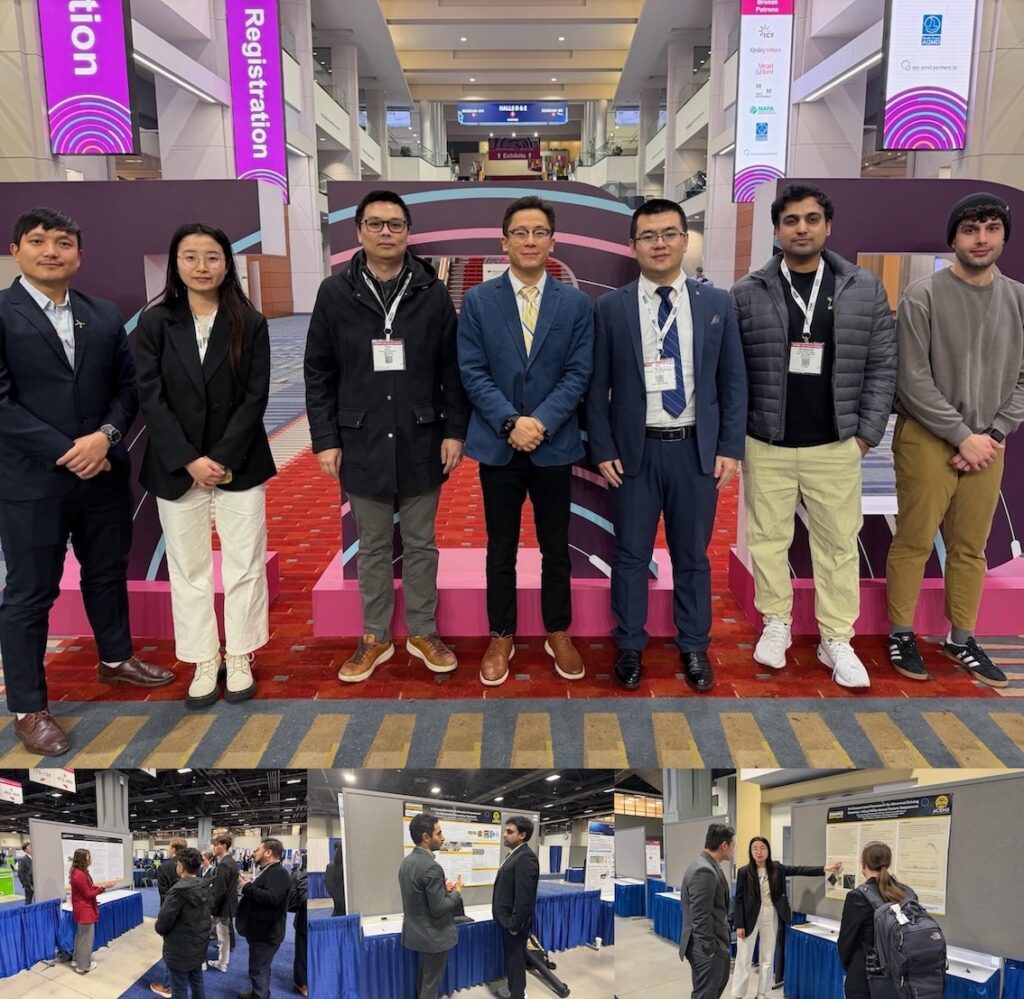
Researchers and students from IPIT attended the 105th Transportation Research Board (TRB) Annual Meeting in Washington, D.C., from January 11–15, 2026, presenting thirteen papers covering a range of critical transportation research topics. Throughout the conference, they engaged in discussions with researchers and practitioners across academia, government, and industry. The experience provided an excellent platform to showcase IPIT’s latest research, receive valuable feedback, and explore potential collaborative opportunities.

Presented Posters:

Southeastern Wisconsin Transportation Symposium Draws Record Attendance

Leadership attending the event included, from left: WisDOT Deputy Secretary Scott Lawry; WisDOT Secretary Kristina Boardman; Victoria Sheehan, executive director of the Transportation Research Board of the National Academies of Sciences, Engineering and Medicine; IPIT Director and professor Xiao Qin; CEAS Associate Dean Andy Graettinger; Kris O’Connor, UWM Associate Vice Provost for Research; UWM Graduate School Dean Bryan Porter; and CEAS Dean Brett Peters.

The 2025 Southeastern Wisconsin Transportation Symposium, co-hosted by UWM’s Institute for Physical Infrastructure and Transportation (IPIT) and the Wisconsin Department of Transportation (WisDOT), brought together more than 220 transportation professionals, researchers, and students on October 10 at the UWM Student Union—the largest turnout in the event’s history!

The symposium featured engaging presentations and discussions on topics such as artificial intelligence in transportation systems, driver behavior and safety innovations, infrastructure preservation, and regional mobility planning. The event showcased collaborative research that advances Wisconsin’s transportation systems and reflects IPIT’s growing impact in connecting academia, industry, and government partners.

Read the Full Story

How math and impatient driving inspired student’s award-winning startup

UWM PhD student Joel Roberts is the founder of Shepherd Traffic, a company that uses computer vision, geometry and smart algorithms to capture more detailed and accurate traffic data than what’s currently available. (UWM Photo/Laura Otto)

Frustrated by sitting at red lights with no cross traffic, UWM PhD student Joel Roberts turned a daily annoyance into innovation. His startup, Shepherd Traffic, uses computer vision and algorithms to automate traffic data collection—providing more detailed, accurate, and cost-effective insights for smarter signal timing and road design.

Roberts’ pitch earned the $2,500 grand prize at the WiSys Big Idea Pitch Competition, standing out among top student innovators across Wisconsin. His system not only counts vehicles, bikes, and pedestrians but also tracks trajectories and delay times—offering a scalable, real-time solution far beyond manual clipboards.

Backed by UWM’s Lubar Entrepreneurship Center and mentored by Civil Engineering Professor Xiao Qin, Roberts integrates his startup into his academic research. With support from the national I-Corps program, he’s now exploring ways to expand his system to include near-miss detection and risky behavior forecasting—insights that could revolutionize intersection design and urban safety.

As cities move toward smarter infrastructure, Shepherd Traffic is helping lead the way.

Read Completed Article

TAPCO Donates Advanced Traffic Equipment to Support Student Learning at IPIT

Andrew Graettinger, CEAS associate dean for research (from left), Lindsay Harvey (from right), TAPCO’s Senior ITS Development Manager, and Xiao Qin, professor and director of UWM’s Institute for Physical Infrastructure and Transportation, are ready for the big reveal!

On May 16, 2025, Traffic & Parking Control Company, LLC (TAPCO) generously donated advanced traffic equipment to UWM’s Institute for Physical Infrastructure and Transportation (IPIT), enhancing hands-on learning for civil engineering students. The donation, including a state-of-the-art SWARCO McCain 352i ATC Cabinet and accessible pedestrian crosswalk buttons, was unveiled at a ribbon-cutting event attended by TAPCO representatives, faculty, and students. This real-world equipment will be used for classroom instruction and research, supporting student development and promoting community safety. TAPCO’s partnership reflects a shared commitment to innovation in traffic engineering and accessible transportation infrastructure.

Read Complete Article

Joely Overstreet Awarded Beimborn Graduate Fellowship in Transportation

Master’s student Joely Overstreet (Civil Engineering) has been awarded the 2024–2025 Beimborn Graduate Fellowship, receiving $7,500 to support her research on improving pedestrian visibility from tall vehicles, advised by Professor Xiao Qin. Overstreet earned her BS in Civil Engineering and Mathematics from Valparaiso University in 2024.

The fellowship was established by donors Curtis C. and Maureen E. Lueck to honor Professor Emeritus Edward Beimborn, recognizing excellence in transportation research.

Read Complete Article

Dr. Shi Leads UWM Research on Autonomous Vehicles, Featured in TMJ4 Interview

TMJ4 reporter Charles Benson (center, foreground) interviews assistant professor Tom Shi (left, center), and doctoral students Fahad Muhammad (far left) and Narayan Rai, both in civil & environmental engineering.

Xiaowei (Tom) Shi, an assistant professor at the University of Wisconsin-Milwaukee (UWM), was recently interviewed about his research into autonomous vehicle technology, particularly its applications in rural and tribal communities. This initiative is supported by a $1.4 million grant from the U.S. Department of Transportation, part of a larger $15 million allocation aimed at advancing self-driving technologies in less urbanized areas. Dr. Shi emphasized that this funding enables UWM to conduct vital testing of autonomous vehicles in rural settings, addressing unique challenges and opportunities in these regions. Transportation Secretary Sean Duffy highlighted the national significance of this research, citing potential improvements in safety and national security. The project’s goal is to enhance the safety and efficiency of autonomous vehicles, especially in areas with limited transportation options.

Read the Complete Article

Watch the Segment

College awarded $1.4 million to address rural transportation needs with autonomous vehicles

Tom Shi, assistant professor; Xiao Qin, professor; and Yang Li, research associate, civil engineering, are partners with UW-Madison on a six-year U.S. Department of Transportation grant to explore the use of autonomous vehicles in rural areas where transportation services are limited. The college’s share of the grant is $1.4 million.

Read Complete Article

Shi’s work is transforming traffic data into road safety solutions

Dr. Tom Shi

Tom Shi’s lab at UWM are developing a data-driven system to improve road safety by tracking risky driving behaviors in real-time. Partnering with the UWM Police Department, they analyze traffic footage using deep learning algorithms to detect behaviors like distracted driving and speeding. Their system creates 3D digital maps with detailed vehicle and pedestrian data to identify unsafe road conditions, such as pedestrian hotspots where drivers fail to yield. The final goal is to develop an intervention system that provides real-time alerts for risky driving, potentially integrating C-V2X communication technology to warn drivers via a roadside unit or mobile app.

Read Complete Article

Northwestern Mutual Data Science Institute funds more faculty and student projects

Faculty awarded include (clockwise from left) McRoy, Nosonovsky, Rahman, Shi and Zhao

The Northwestern Mutual Data Science Institute (NMDSI) has awarded over $700,000 in grants through three annual programs that support cross-institution collaboration in data science research and education. As part of a long-term commitment, UWM, Marquette University, and Northwestern Mutual will invest $35 million over the next five years to position Wisconsin as a hub for data science and technology. Awardees from UWM include faculty and students working on AI-driven rehabilitation, rural connectivity, digital twin risk prediction, and explainable AI for healthcare. The funded programs—Paving ROADS Seed Fund, Pioneer Collaborative Curricula, and Student Research Scholars—aim to advance interdisciplinary research, integrate data science into curricula, and engage students in cutting-edge projects.

Read Complete Article

IPIT and WisDOT host annual Southeast Wisconsin Transportation Symposium

Xiao Qin, IPIT director and the Lawrence E. Sivak Professor in Civil & Environmental Engineering, opens the symposium.

The 2024 Southeast Wisconsin Transportation Symposium, co-hosted by UWM’s Institute for Physical Infrastructure and Transportation (IPIT) and WisDOT, brought together over 200 students, professionals, and researchers to explore innovative solutions in transportation. Key topics included pedestrian and bicyclist safety, Milwaukee’s Vision Zero program, and emerging trends in autonomous vehicles. UWM researchers Robert Schneider and Xiao Qin presented their study on rising pedestrian fatalities, offering insights into trends and potential solutions. The event featured engaging sessions, keynote speeches, and a “walk-shop” tour of UWM’s latest pedestrian facilities.

Read Complete Article