Teaching Assistants with graded courses will be evaluated by their students each semester just as faculty. These take the form of an online survey distributed to students near the end of the semester by the UWM Office of Assessment and Institutional Research (OAIR).
There are other opportunities for evaluation as well, such as informal midterm evaluations created by the program, supervisor, or even by the Teaching Assistant. Midterm teaching evaluations are designed to solicit feedback during the course, so that improvements can be made before the course is over. Midterm evaluations are especially encouraged for new Teaching Assistants who may not have the experience to perceive what might need improvement. Soliciting midterm evaluation shows students that the Teaching Assistant values student input, which can be motivating to students. It also can help teachers detect miscommunication or misunderstanding that might impact the course much later.
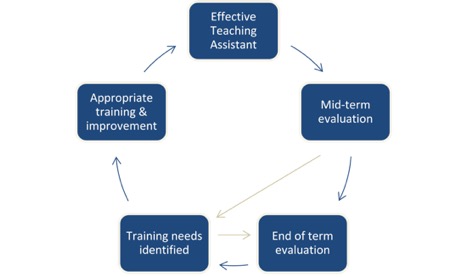
Ideally, evaluation will be combined with supervision and additional training in a cycle of continuous improvement. Supervisors can help assistants digest feedback, identify what is already working well and what might be improved, and provide additional training or guidance. The effectiveness of the training strategies can then be assessed at the end of term evaluation, where further training needs may be identified. See Figure 1 below for a diagram of a cycle of evaluation, training, and improvement.
Other forms of teaching evaluation are also valuable. Supervisors or even peers can observe an assistant’s teaching and provide immediate feedback from the perspective of another teacher. Classroom observations should be conducted thoughtfully to maximize their value for the teaching assistant’s development.
Guidelines for Observing TA Teaching
Preparing for the Observation Before observing, the observer should meet with the teaching assistant to discuss the purpose and focus of the observation. This conversation should establish what specific aspects of teaching the TA would like feedback on, such as clarity of explanations, student engagement techniques, or time management. The observer should also understand the lesson’s objectives and the TA’s planned approach.
During the Observation Observers should take detailed notes focusing on both strengths and areas for improvement. Pay attention to how the TA interacts with students, explains concepts, manages classroom dynamics, and adapts to student responses. Note specific examples of effective teaching moments as well as opportunities for growth. Avoid being disruptive to the class flow.
Post-Observation Discussion Schedule a follow-up meeting within a few days of the observation. Begin by asking the TA to reflect on how they felt the class went before sharing observations. Focus the conversation on specific, actionable feedback rather than general impressions. Collaboratively identify 1-2 key areas for improvement and discuss concrete strategies for enhancement. Some programs might provide forms for assistants and observers to fill out to help facilitate feedback and guide the conversation.
Teaching assistants also should be intentional about observing their own performance. Making brief notes after class about what worked well and what might work better can help them improve steadily and can make periodic meetings with supervisors more productive.
Portions of this page were written with assistance from Claude 4.
Previous Topic
Next Topic