02.22.2024
In Conversation with Coby-Dillon English
By Jacob Collins
Have you ever wondered what your relationship with someone would be like if you had met them at a different time in your life? Coby-Dillon English explores this idea in their short story, “First Date, Last Night”, which appears in the latest issue of CCR. I had the chance to talk to them about their story’s themes and their writing process.
JC: What was the inspiration behind this story?
CDE: I can’t really pinpoint my inspiration for this piece. Some stories take me a long time, and this was one I wrote over many years. I wrote the initial scene with Leslie’s name over four years ago and then set it aside. Then the form of the continuous first date came to me much later. I am working on a collection of insomnia stories, and for this story, I was thinking about the experience of playing a scene or situation over and over again in your head when you can’t sleep, questioning if you made the right choices, what could have gone differently, etc. That’s where I started with the story, that scene of a first date and that idea of spiraling around the same night, and the rest slowly formed around those two elements.
JC: This story is told in fragments, with sudden jumps into the past and future of Naomi and Leslie’s relationship. What made you choose this style of presenting the story over, say, a more linear one?
CDE: Short answer is because I find that more interesting! Longer answer is that, for me, the timeline in this story is a contradictory one. A lot of the scenes in the present or future are moments I view as possibilities, not exactly hard truths. Certain facets of the first date change, which then change those outcomes. Many of the dates fail, and thus have no future as it pertains to the story. All those possible changes and possible futures become all knotted together and I wanted the story to mirror that feeling.
JC: So much of this story takes place on Thursdays, especially Thursdays in September. What, to you, is the significance of this?
CDE: For the most part, this had a lot to do with setting. I wanted a moment in time to be our marker in this story, either as a sign that we are returning to something or to mark how far we have come. And the setting of Chicago was always clear to me. I was born in Chicago and have lived there in the past, and it is a city and a people that I love deeply. When I think about Chicago, I think of Chicago in the late summer, when it is bright, warm, and social. When I was thinking of a moment in time and space that I wanted to continuously write around, it was Chicago and late summer, and so that certainly influenced that choice.
JC: Names play an important role in this story, between Leslie not liking his name and Robin and Riley having unisex names despite Leslie’s desire to give them masculine names. It’s an interesting theme – what does it tell us about Leslie?
CDE: This is a story about the birth of a family, the various expectations of family making, and for me, gender is a big part of that. I was raised with certain ideas surrounding masculinity, as all people are in some way, and the names in this story were something I could play around with that spoke to those gender expectations. Leslie is a character who, at best, feels murky about who he is, as a man and as a person, and his name was a great way to expose that feeling. His name is a kind of live wire of masculinity that he is constantly being forced to reckon with. When thinking about the sons’ names, I was thinking about how people put a lot of expectations for themselves on their children. Giving his sons unisex names was a way to acknowledge that having sons was not going to save Leslie from the work of figuring out his own character.
JC: There are two scenes in the story in which Naomi seems to give up parts of herself to Leslie, specifically on the train when “Naomi felt two rib bones break off inside, making room for a man like Leslie” and when the two of them are talking about wanting kids and “Naomi plucked two molars from her mouth and offered them up to Leslie in the dim light.” What does this say about the nature of relationships?
CDE: I’m not sure what this says about the nature of all relationships, but for this one in particular, it’s a bit of a willing sacrifice. If Leslie doesn’t know who he is, Naomi doesn’t know what she wants, and she’s willing to give up pieces of herself in order to figure it out. Naomi has the confidence in herself to not lose her entire personhood in a relationship, but she can offer up a piece here and there.
JC: Leslie and Naomi go back and forth a lot in their relationship, constantly separating and coming back together again, but ultimately they stay together in the end. When you started writing this story, did you know what their fates would be?
CDE: Eventually, I did. For a while, the story was just a handful of scenes; I didn’t know what any of it would be. But once I realized the form it wanted to take, the ending was very clear to me. In order to explore the possibilities of who Leslie and Naomi could be to one another, I had to know where they would end up. The harder work was figuring out how we got there.
JC: You’re currently completing an MFA at the University of Virginia. What has that experience been like?
CDE: The worst part is that it is coming to an end soon! I am very grateful to have had the privilege to study literature and writing for the past few years and to do so alongside some incredible writers and scholars. I have deep, deep admiration for my cohort, who are all brilliant, marvelous, and talented people. Literature and people are the most important things in the world to me, and I’ve been lucky enough to spend my time with some spectacular instances of both.
Bios
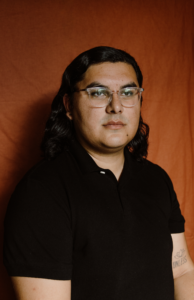
Coby-Dillon English (they/them) is a writer from the Great Lakes. A member of the Mississippi Band of Choctaw Indians, they are currently an MFA fiction candidate at the University of Virginia. Their writing can be found in Salt Hill Journal, Moon City Review, Yellow Medicine Review, and others.
Jacob Collins is an undergraduate student majoring in English on the Creative Writing track. He says that the best thing about interning at CCR has been reading the wide variety of stories that people from all walks of life submit for publication. Outside of school, he likes reading, writing, and playing D&D with his friends.
02.05.2023
Issue 46.2 on Project Muse
Winter/Spring 2023 Issue 46.2 can be found on Project Muse. Print copies will be available soon and mailed out to our subscribers!
10.09.2020
Results of the 2020 Summer Prize in Fiction and Poetry
We’d like to thank everyone who submitted to our 2020 Summer Prize in Fiction and Poetry. Without you, this would not have been possible, and we are grateful for your participation and trust in our journal. Please join us in congratulating the winners, runner-ups, and finalists of the 2020 Summer Prize!
Winner of the 2020 Fiction Prize selected by Lucy Tan:
“The Hampton Roads Bridge Tunnel” by Leah Fretwell

Lucy Tan says, “’The Hampton Roads Bridge Tunnel,’ a story about the frailty of all we hold near in the face of death–whether it be religion, blood connection, or the stories we grow up telling ourselves. Here, horror is mixed with strange tenderness and humor, and the story’s fractured form captures truth about the human spirit and the way we grieve. This is the work of a writer with incredible heart and surprising range.”
Leah Fretwell’s fiction has appeared in Inscape and online at the Southern Humanities Review.
Runner-Up of the 2020 Fiction Prize selected by Lucy Tan:
“A Few Perfect Innings” by Ryan Lackey

Lucy Tan says, “‘A Few Perfect Innings’ is an inventive and powerful story about rage, obsession, and inheritance. I was drawn in by the intimacy and specificity with which this author crafts characters and their psychologies. I also admired the way suspense builds beneath carefully managed voice and tone.”
Ryan Lackey is a PhD student at the University of California, Berkeley. His writing has appeared with Literary Hub, Los Angeles Review of Books, Public Books, Chicago Review, and elsewhere. He tweets @rlackey15.
Finalists:
“The Blackberry Flu” by Hailey Foglio
“Atargatis” by Banah Ghadbian
“Color Theory for the Currents at Night” by Claire Oleson
“Clean Slate” by Tara Ramirez
“Water Day” by Manisha Sharma
“The Lightning Jar” by Emily Woodworth
Winner of the 2020 Poetry Prize selected by E.J. Koh:
“For My Own 34th Birthday” by Maria Picone

E.J. Koh says, “‘For my own 34th birthday’ is a disentanglement of the politics of belonging and the everyday trauma of un-belonging. ‘No in-between,’ as in, the unbearable, generational suffering that divides women and countries and language. This winning poem translates the untranslatable; and it refuses any one answer.”
Maria S. Picone (she/her/hers) writes, paints, and teaches from her home in South Carolina. Her publications include flash fiction, CNF, poetry, translation, visual art, and hybrid work. Her writing has been published in Kissing Dynamite, Emerge Literary Journal, and *82 Review, among others. She has work forthcoming in Whale Road Review, Parentheses Journal, Moonchild Magazine, and others. A Korean adoptee, Maria often explores themes of identity, exile, and social issues facing Asian Americans. She received an MFA in fiction from Goddard College and holds degrees in philosophy and political science. You can find more on her website, mariaspicone.com, or Twitter @mspicone.
Runner-Up of the 2020 Poetry Prize selected by E.J. Koh:
“The Fire Consumes, The Fire Produces” by Caroline Chavatel

E.J. Koh says, “The Fire Consumes, The Fire Produces” begins: “I dig my own grave daily.” The ‘I’ is a mythology that guides the reader closer to themselves. There is magic here in the simultaneity of opposites, the reversal of perceived differences, and the ecosystem of everyday things and their inner lives.
Caroline Chavatel is the author of White Noises (Greentower Press, 2019), which won The Laurel Review’s 2018 Midwest Chapbook Contest. Her work has appeared in Sixth Finch, Foundry, Poetry Northwest, AGNI, and Gulf Coast, among others. She is an editor at Madhouse Press and co-founding editor of The Shore. She is currently a PhD student at Georgia State University where she teaches and is Poetry Editor of New South.
Finalists:
“Consume (Mad Study IV)” by Rob Colgate
“Mother and Son as Oyakodon” by Michael Frazier
“Second Movement: The Boy y El Hombre Que Se Comió El Relámpago” by Saúl Hernández
“Rocket Ships” by Yuki Jackson
“River” by Cindy Juyoung Ok
“An American Self-Destructs into the American” by Jenifer Sang Eun Park
“Inlet” by Ilari Pass
“How to Resurrect a Chicken” by Danni Quintos
* * *
Thank you all again for your wonderful work. Be sure to keep an eye out for our Winter Issue 44.2 to read these winning works!
*Banner art: from Gabriel Silva’s “Gold 1”, which appears in Issue 42.2 of Cream City Review.
08.13.2020
Room for Something Unwieldy by Christine Robbins
Christine Robbins writes about her poem “Wake.” You can read “Wake” in Issue 42.1 of Cream City Review and by clicking here.
*
A few years ago, the poem was two stanzas and less than a page long, with a uniform left margin. It was titled “If we’re saved by what we can’t leave.” We keep a flock of pigeons in a loft behind our house, and if they are released too early in the spring, they become meals for the hawk and peregrine falcon. The poem was about these birds and the tension between being responsible for others’ safety, but also for their freedom, and possibly even their joy.
I have a fair amount of angst around “keeping,” but my concerns were more submerged in this earlier version. The poem expanded to over four pages with more white space, shorter lines, and a back and forth swing to the stanzas. I had been playing with a form that would allow room for two voices, or the braiding together of two or more poems that felt somewhat flat to me, as this original did. But the right justification of alternating short stanzas evolved into a much-needed space for my own voice to contradict itself.
This form became so compelling to me that I haven’t used another since. I think the stanza movement provides room for something unwieldy to drop into the poem and maybe alter the meaning of a word as it’s approached from a different angle. Also, the original version felt more like an artifact – the lines were the result of a creative process that happened elsewhere, and this poem documents the process on the page. It’s messier, and I hope it has more of a pulse. It’s also more vulnerable – I’m leaving more of myself on the page. I think the poem gains urgency in the process, and I want this, but it also engages more of what I’m only on the edge of understanding myself, and the diminished control feels riskier to me.
I find the idea of decomposition compelling, and the poem circles this concept – as organic matter, but also as the concept of un-writing. A being can never un-be, and words can never be taken back – not really. I am aware of my ambivalence for declarative sentences, but I’ve also been thinking about how urgent they can be in a political climate that continues to threaten the existence of so many people. I tend to claim questioning as a stance, or even an essential part of who I am, but that can be taken too far. I also need to know what I can definitively say, and it is important to me to stand behind those whose lives are at risk. When we are not safe, we need to know who is with us. I am also watching for the “I,” and aware that everything I see in others comes through my filter and I am accountable to this lens.
For the last eight years, I have had progressive trouble with my mobility and speech. It is probably not surprising that my lines have grown shorter as my capacity to physically and verbally move across space has diminished and become more halting. I am aware that the poems I’ve written recently are almost all long. If I have the floor, I have a lot to say. But it is also relevant that I don’t know why I have this trouble – I don’t have a diagnosis, and this contributes to my desire to look at language from different angles. My own language is altered from a speech disorder, but language itself might alter my perspective, if I ever learn the word I do not yet know. And since I do not have certainty (and really, do we ever?), could I wake up tomorrow and run? Will this unnamed thing kill me? Is it all in my mind?
One thing is certain: I do not want to waste time. Which means, I want to be accountable to the people I love, and in a smaller way, to this world of people. I want to write what I’m compelled to write. I want to be free to name my own mistakes. I want to be awake.
*
In addition to Cream City Review, Christine Robbins has been published in journals including Beloit Poetry Journal, The Georgia Review, New England Review, and Poetry Northwest. She was a finalist for the National Poetry Series and she lives and works in Olympia, Washington.
07.03.2020
Interview with 2020 Poetry Prize Judge E.J. Koh
This year’s Cream City Review Summer Prize in Poetry will be judged by the poet and memoirist E.J. Koh. In this micro-interview conducted by Editor-in-Chief, Su Cho, E.J. discusses moments of surprise during her writing process, what makes a poem memorable, and what she’s working on now. Read on for the full interview.

E.J. Koh is the author of the poetry collection A Lesser Love (Louisiana State University Press, 2017), winner of the Pleiades Editors Prize for Poetry and the memoir The Magical Language of Others (Tin House Books, 2020). You can learn more at www.thisisejkoh.com.
*
1. I’m so glad I got to see you read from your memoir, The Magical Language of Others, at Boswell Books in Milwaukee this year! I couldn’t help but notice that you opened your talk with a very generous explanation of 잘 부탁합니다 (jal butak hapnida) and how your poetry collection A Lesser Love opens with “Showtime,” which also summons this phrase of goodwill and trust. You say, “This translates into, Please be kind to me / but it suggests: // Even if I shame myself, / please be kind to me. This might be a selfish question, but what made you choose the formal phrasing instead of the informal?
My spoken Korean tends to be formal. Korean was the language for home, church, and times with my grandmother, who brought me along on visits with her friends in Milpitas, California. My mother would laugh because I sometimes use phrases that are now out-of-style or might date me to the time when my parents immigrated to the States. My Korean is, in some ways, trapped in time.
2. I’m always taken by the voices in your poems—as though their footsteps walk with me through the book. There’s such an alluring inhabitance of the places we explore. I feel like everything is watching, alive, and demands urgency. Could you talk more about voice, and how you cultivate it in your poetry and/or prose? Is there a difference for you? I’m particularly struck by the last poem “Alki the Town of Dreams” and the couplet “As casual as a bird sailing into its fullest wingspan / towards me, as if he’d been there since the beginning.” Can you talk about this presence in the book? Was it something consciously woven into the book or did it come naturally?
I read the poem aloud as I’m writing it. If you sit by me, you can hear me say each word. The practice of reading out loud has been with me since the beginning. The voice a reader hears is the voice I’m speaking through. If you asked me to write quietly, poetry or prose, it would be difficult. I imagined my work to be read the same way—to be spoken into a room, connecting acts of writing and reading intimately.
3. It was really nice to see how the themes from A Lesser Love resonated through your memoir, The Magical Language of Others. The complexities of belonging, maintaining relationships, and grappling with the tethers of life were comforting and eye-opening for me. So much of it is navigated through language, translation, and interpretation. You so generously outline it for the reader in the memoir—were there moments you felt protective of your knowledge and/or experiences?
I feel open. There are things left unsaid or stretches of quiet. My hope was not to keep the reader out but to allow for possibilities. Fluidity rather than stiffness; where things could’ve gone right, not only where they’ve all gone wrong.
4. Were there moments of surprise and delight while you wrote A Lesser Love and The Magical Language of Others?
The poetry book and memoir were published close together. In that time, I reunited with my family in Seattle. I fell in love with somebody. I started a family. I focused on my mental and physical health. I began rock climbing. I started going into the water. I was writing and reading, gently. What surprised me was how I learned to take care of myself. How I learned the books could take care of themselves without me.
5. What are you working on now?
A novel is coming. I’m curiously walking along the path of fiction. I’m reading, writing, and researching. Listening, watching, asking questions. I love the making of a book.
6. And lastly, what makes a poem memorable to you? In your own writing process, how do you determine if a piece of work is ready for the world?
To see if a poem is ready, I look at how I am in the world. The poem itself can be written without end. But I ask if I can let it go. Sometimes, I’m not able to. It’s not done with me. The poem has to change me, and I have to accept that change, then show it through the evidence of my life to say that I can move on.
*
Submissions to the 2020 Summer Prizes in Fiction & Poetry are open until August 1st. Click here for the full guidelines!