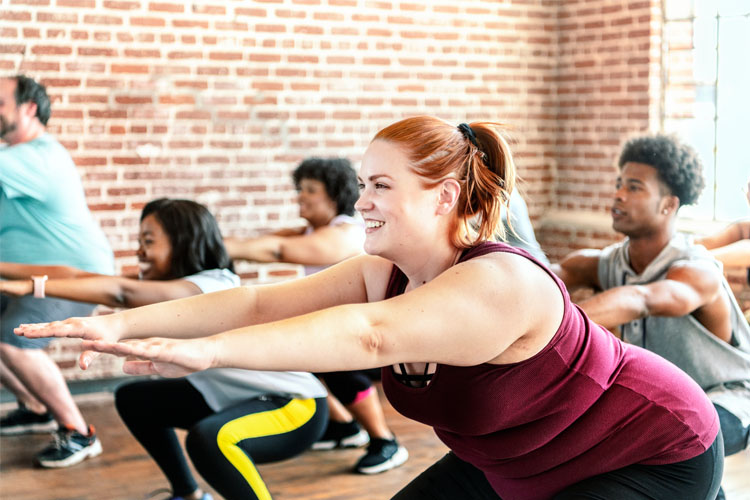
As Body Acceptance Week approaches later this October, new pilot research from the UWM Joseph J. Zilber College of Public Health offers a different way to think about the relationship between physical activity and our bodies: focusing less on how the body looks and more on how it feels, functions and allows us to experience the world.
Christy Greenleaf, PhD, professor of kinesiology and co-director of the Body Image Research Lab at the Zilber College, recently presented the research at the 2026 North American Society for the Psychology of Sport and Physical Activity conference. She conducted the study with undergraduate public health student Jordan Koeller and master’s kinesiology student Alexa Newhouse.
Their work explores embodiment during physical activity — the experience of being aware of and connected to the body from the inside rather than viewing it primarily in terms of appearance, weight or performance.
Embodiment can include feeling comfortable and connected to the body, appreciating what it can do, feeling capable and strong, and noticing and responding to physical and emotional needs.
Asking how movement feels
For the pilot study, college students provided written responses describing their experiences during physical activity. Two of the most common themes were body connection and comfort, and agency and functionality.
Students described being present in their bodies, noticing their breathing and movement, and appreciating what their bodies allowed them to do. Some viewed physical activity as a form of self-care that supported their overall well-being.
Positive experiences of embodiment also appeared to influence students’ motivation to remain physically active. Rather than emphasizing calories burned, appearance or changing their bodies, students often focused on how movement felt and how they felt in their bodies while doing it.
The findings suggest there may be value in approaching physical activity from a different perspective.
Instead of asking primarily, “How will this change my body?” people might also notice strength, energy, balance, breathing, movement or simply the feeling of being present and connected to their bodies.
Body experiences can change from day to day
The research also highlights that embodiment is not necessarily a fixed experience.
Students reported that factors including stress, mood, fatigue, sleep, physical comfort and their environment affected how they experienced their bodies during physical activity.
Recognizing those changes may offer another opportunity for people to listen to their bodies rather than judge them. A type or intensity of movement that feels good one day may feel very different another day.
That perspective aligns closely with the goals of Body Acceptance Week, an initiative that encourages greater body acceptance and challenges the idea that a person’s appearance or body size determines their value. Body Acceptance Week is observed during the third week of October.
Shifting the question
The study is preliminary, but Greenleaf says it points toward a potentially valuable change in how people think about physical activity and their bodies.
Rather than focusing primarily on “How does my body look?” the research invites another set of questions:
How does it feel to be in my body? What can my body help me experience? What can it do?
For college students navigating messages about appearance, fitness and body ideals, physical activity may provide an opportunity not simply to work on the body, but to experience it through connection, capability, appreciation and care.
The research was presented as:
Greenleaf, C., Koeller, J., & Newhouse, A. (2026). “I feel connected and present”: Pilot research exploring embodied physical activity among college students. Journal of Sport & Exercise Psychology, 48(S1).